

 |
Russia
Alexander Solzhenitsyn dies
Article published on the 2008-08-04 Latest update 2008-08-04 14:46 TU
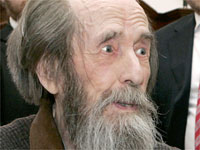
Alexander Solzhenitsyn, June 12, 2007
Alexander Solzhenitsyn, winner of the Nobel Prize for Literature in 1970 and author of The First Circle and The Gulag Archipelago, has died. He suffered heart failure at his home in Moscow late Sunday.
"One day Dostoevsky threw out the enigmatic remark: 'Beauty will save the world'. What sort of a statement is that? For a long time I considered it mere words. How could that be possible? When in bloodthirsty history did beauty ever save anyone from anything? Ennobled, uplifted, yes - but whom has it saved?"
-- Solzynitsyn in his acceptance speech for the Nobel Prize for Literature, 1970
On the day Stalin died, in 1953, Alexander Solzhenitsyn was released from a Soviet labour camp. He had been incarcerated after describing Stalin as a "poor theorist" and "a mediocre strategist" in a letter. He became known in the West in 1962 with the publication of One Day in the Life of Ivan Denisovich.
Ivan Denisovich was followed in 1968 with The First Circle (a reference to the circles of Dante's Inferno) and Cancer Ward; the latter was banned from publication in the Soviet Union.
Solzhenitsyn's acceptance speech for the Nobel was smuggled out of the Soviet Union in a radio case by Stig Fredrickson. Fredrickson spoke to RFI on Monday about the author. He said Solzhenitsyn had seen his mission as "to testify on behalf of the millions that did not survive".
Following his Nobel Prize win, he went on to publish The Gulag Archipelago in installments in Paris in the 1970s. In the midst of publishing this work the head of the KGB had him expelled from the Soviet Union. He moved to Switzerland and then to Vermont in the United States. Only in 1989 was the work published in his home country. Five years later he returned home.
The Russian government gradually softened its stance on Solzhenitsyn and in 2007 awarded him the State Prize by Vladimir Putin in 2007.
Georges Nivat, author of several studies on Solzhenitsyn, told RFI that it was "the end of a giant". He compared the Russian novelist to Victor Hugo insofar as he "married literature and politics" and said of Solzhenitsyn that "The historical person and the writer cannot be separated".
He will be buried on Wednesday at the Donskoye cemetary in Moscow. He is survived by his wife Natalya and son Stepan.
Reaction
"A heavy loss for the whole of Russia. We are proud that Alexander Isayevich Solzhenitsyn was our countryman and contemporary. We will remember him as a strong, brave person with enormous dignity". Vladimir Putin
"Until the end of his days he fought for Russia, not only to move away from its totalitarian past but also to have a worthy future, to become a truly free and democratic country. We owe him a lot". Mikhail Gorbachev
"A great and important writer who, through his work, played a decisive role in bringing down the communist totalitarian system". Angela Merkel
"His intransigence, his ideals and his long, eventful life make Solzhenitsyn a hero from a novel, an heir to Dostoyevsky." Nicolas Sarkozy
"Solzhenitsyn will be remembered as an intellectual who provided us with a testimony, tinged with suffering, and a sharp and accurate view on the tragedies of 20th century totalitarianism." Jacques Chirac
Bibliography
http://nobelprize.org/nobel_prizes/literature/laureates/1970/solzhenitsyn-bibl.html