

 |
Canal tour
Redeveloping the industrial revolution
by Sarah Elzas
Article published on the 2008-08-08 Latest update 2009-02-27 09:15 TU
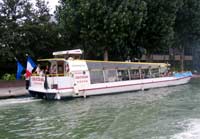
A boat on the Ourq canal
(Photo: Nissim Schaul)
During the hot and muggy summer heat, Parisians yearning for the beach make do with the Seine River. But there are more bodies of water in the city: a whole network of canals heading north that were once part of a large shipping network.
Culture: A trip on the Canal d'Ourq
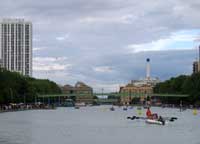
View of the canal d'Ourq in Paris
(Photo: Nissim Schaul)
Today the factories that used to flank the canal have moved away, and the water flows through towns that are more known for burning cars and riots than for waterfront housing. But redevelopment plans are trying to change that image.
The tourist committee for Seine-Saint-Denis, the department north of Paris, has been offering one euro weekend boat visit of the Ourq canal this summer. You can catch a boat at the La Villette basin, a wide part of the canal in northern Paris surrounded by art house movie theatres and apartment buildings with canal views.
The boat goes along eight kilometres of water and 200 years of history. "Our friend Napoleon the First was the first one who thought about the canal, at the beginning of the 19th century," explains Jean Barthélemi Debost, a local historical preservationist, who was giving a tour on board recently. The canal was initially created as river to bring drinking water to Paris from the Picardie region.
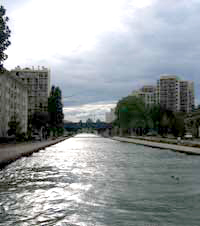
View of the Ourq canal from Pantin
(Photo: Nissim Schaul)
"But very quickly afterwards, it seemed very convenient to have some boats bringing all the grains from la Brie," says Debost. Brie is a fertile agricultural region in the north of France. Vestiges of the canal's commercial uses are apparent even in Paris, at La Villette Park, which used to be where livestock was brought into the city for slaughter. It is now a park, and houses a science centre and music venues.
The first town on the canal outside of Paris is Pantin, which Debost says was one of the biggest industrial towns at the middle of the 19th century. "Now at the canal there are only traces of this history," he explains. "Most of the banks are now occupied by houses, but you still can see the big mill of Pantin." The former flour mill is huge, with an almost Gothic curved pointed roof. A crane hangs above it, as it's in being remodelled to house the offices of the BNP bank.
The Pantin millThe boat continues through Bobigny, a working class town with many housing projects. Back in 2005, it was the site of some of the violence that was sparked in Clichy sous Bois, just a few km northwest. Empty factory buildings line the canal here. "The canal is very interesting because it gives a transversal view up from Paris," says Debost. "The transformations are coming from Paris and are spreading along the canal." 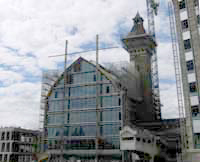
(Photo: Nissim Schaul)
Cities started thinking about redeveloping their canal waterfronts about ten or fifteen years ago. Paris has been developing and improving its Saint Martin canal, which is now bordered by trendy shops and cafes. The boat tour finishes in Bondy, even bleaker than Bobigny, with big-box stores and a few active factories on the canal.
The trip has shown a side of the city that many people don't get to see: a gritty, industrial side that is in the process of renewal. Daniel Orantin, the director of the tourism committee, says the tours were put in place for locals, who know the canal but don't really use it. "Because there are not many possibilities to see the city from the canal," he says. "Of course I say it's for them, but we are a tourism committee, so we're looking into the future."
Tourism in the north of Paris is mostly focused farther north, on the St. Denis basilica, where the kings of France are buried or the Stade de France sports stadium. The Seine-Saint-Denis tourism committee is exploring ways to expand tourism to the canal.
"There are so many tourists," he says. "In order for Paris to remain the top tourist destination in the world, we need to expand the perimeter." "We think there's a future for tourist activities here that are different form the centre of Paris," says Orantin. "But of course these activities will only work if they are used by the locals. So this is a trial activity, which has been working well."
Indeed, the tours have been packed, and people have had to be turned away. The boat tours continue through 31 August.
Seine St. Denis tourism website (french only)
Culture

Cracking skulls!
Fascination with death reaches new heights in an exhibition guaranteed to make you touch your head and feel thankful it is not made out of colouring crayons, or flies!
2010-02-15 12:35 TU

France's gothic avant-garde
A new show reveals an avant-garde Paris in the 13th century creating “total art” that spread from architecture to all art forms and went on to conquer much of Europe.
2010-02-13 15:16 TU

Winter sounds warm up French jazz fans
A tribute to trumpeter Don Cherry at a Free Jazz showcase festival outside of Paris.
2010-01-31 11:55 TU

Trance on a trapeze
Ever thought of running away with the circus? The mere idea sounds almost 19th century now, but the art of the circus is alive and well.
2010-01-30 12:41 TU
Retro Mobile - classic car exhibition

260,500 euros for rusty old car found at bottom of lake
A rusty old Bugatti, which spent years at the bottom of a Swiss lake, sold for 260,500 euros at the Retro Mobile classic car exhibition on Saturday. Other more lovingly-restored pristine examples are exciting enthusiasts from across the world in a special anniversary event at Porte de Versailles in Paris.
2010-01-23 20:21 TU

France's changing face looks east
Since its ethnically diverse team won a famous World Cup victory 11 years ago, France has tried to change its image at home and abroad. Bonjour India presents a multicultural French-speaking world to south Asians.
2010-01-22 16:17 TU

Putting art on film
International films about art converge in Paris for a festival at the Louvre from 20-24 January.
2010-01-20 13:09 TU

What sex is a coffee bean, where does the aubergine come from?
Where were eggplants first grown? And what about quinces and clementines. A new book traces the journey of fruit and veg from their countries of origin to our plates.
2010-01-08 16:08 TU

Cocteau Twin flying solo
In the 1980s and 90s, Robin Guthrie was the guitarist whose rippling layers of sound formed a pivotal part of the sound of the British band, the Cocteau Twins. His most recent solo work Songs to Help My Children Sleep was released in November.
2010-01-06 16:43 TU

A taste of Nordic filmmaking in Paris
Ciné Nordica 2009 at Paris’s Panthéon cinema showcases filmmaking from Scandinavia. So what makes Nordic film different from the rest?
2009-12-22 17:15 TU