



 |
Libya/Immigration - interviews
Officials fear 200-plus dead in Libyan boat accident
Article published on the 2009-04-01 Latest update 2009-04-02 10:11 TU
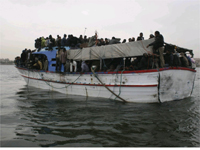
A boat overflowing with migrants, which survived a violent storm, arrives in the port of Tripoli 29 March 2009.
(Photo: Reuters)
Officials fear that more than 200 people are dead after a Libyan vessel carrying illegal immigrants capsized Tuesday. The Libyan coastguard rescued 23 people, and the dramatic event underscores how desperate some people have become to flee their lives in Africa, migration experts say.
Laurence Hart, the head of International Organisation for Migration's Tripoli mission, told RFI that 23 people were saved by Libyan coastguards and 21 bodies have been found so far. The search, he says, will continue but its aim has changed.
Update: Laurence Hart, head of IOM in Tripoli
"In fact, it is a search of bodies rather than a search of migrants at this stage because there is a very slim change that any survivors can be found," he says.
"We have some witnesses that bodies were starting to come ashore on Libyan beaches."
After setting sail around five am local time on Tuesday, a panic broke out aboard the boat over a leak. People rushed to the front of the boat, trying to avoid the on-coming water but this caused the boat to capsize around eight am.
Survivors managed to cling to the back of the boat, despite the rough conditions in the sea, until Libyan vessels rescued them eight hours later at four pm.
Migrants are becoming increasingly desperate in their attempts, says the UN Refugee Agency's spokesperson Laura Boldrini.
Q+A: Laura Boldrini, UN Refugee Agecny spokesperson
"Years ago we could say there was a season for sea crossings, now this is not so any more, people keep coming at any time of the year," she says. "Winter is much more dangerous because the weather conditions change very quickly which means that you may depart and the weather is good and in two hours the weather becomes rough.
"People are taking more and more risks because people are more and more desperate."
In 2008 Italy granted some form of international protection to half the immigrants who applied. Boldrini says this means that many of these people have good reasons to risk their lives because "they have nothing, nothing to lose".
"They play a sort of Russian roulette," Boldrini adds. "They say I have few chances to make it - if I stay in Somalia I risk my life every single day, so it's better I do it once for ever."
According to Hart, all the survivors come from north and sub-Saharan Africa, and are between 18 and 24-years-old. All but one of the 23 survivors are male.
Libya/Immigration

21 dead and hundreds missing after boats sink off Libya's coast
2009-03-31 14:25 TU