

 |
The squatters’ return
by Alison Hird
Article published on the 2009-09-28 Latest update 2009-09-29 11:51 TU
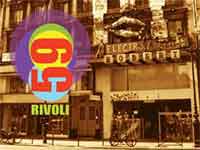
59 Rivoli inauguration poster, showing how the squat was before
(c) Gaspard Delanoe
“Ten years ago we came in through the back door; this time we’ve returned through the front,” says Gaspard Delanoë, head of the 59Rivoli collective, not without a certain pride. For seven years, between 2000 and 2007, Delanoë and a group of fellow idealistic artists squatted an abandoned six-storey building at No 59 rue de Rivoli, in the bustling heart of Paris.
Culture in France: 59 Rivoli
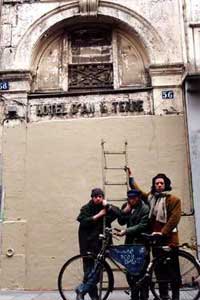
Gaspard Delanoe and friends take possession of the premises back in 2000
(Photo: Gaspard Delanoe)
The "squart", a title invented for artists' squat, rapidly became a hub of underground artistic creation. Tourists would flock just to see its crazy artwork-covered façade, a blaze of colour that stuck out like a welcome sore thumb amidst its pale cream Hausmannian neighbours.
Delanöe says squatting is legitimate.
“There are no other ways for artists, many of whom live precariously, to be able to produce new forms of art and new ways of accessing art,” he explains. “It’s an absolute necessity.”
But a squat’s a squat: it’s illegal, and the collective lived in permanent threat of eviction - until Socialist City Mayor Bertrand Delanoë (no relation), the founder of the Nuit Blanche contemporary art festival and self-acclaimed defender of all things alternative came to the rescue.
City Hall bought the premises from the Credit Lyonnais bank, and invested nearly five million euros into renovating the building and transforming it into workshops.
Today artists pay 130 euros per month for light and electricity, and the public are free to pop in any afternoon.
Twenty former squatters and ten artists-in-residence have settled back in the pristine white, new-look 59Rivoli, but Bertrand Delanoë insists he’s not trying to institutionalise the artistic energy a squat can create.
“I wanted to give a chance to places like 59Rivoli to express art and beauty, but in the least supervised way possible,” he says. “I don’t want to normalise these places. I want to make them safer and give them support.”
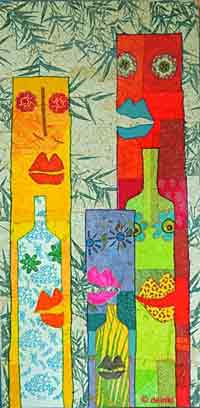
'Le rendez-vous des amis' by Deinki
(c) Deinki
Barry, an American musician who’s been with the collective since 2003, is back on his comfy chair in the ‘Igor Balut museum’, an installation packed floor-to-ceiling with memorabilia and bric à brac.
The guitarist says he makes the museum speak, giving a daily concert, open to the public and any other musicians that care to drop by.
“It’s great to be back. I’m in la la land,” he says, while admitting the collective is still “redefining itself… to see how far we can go with the underground thing”.
Up on the sixth floor artist Deinki now has a bigger, lighter studio, perfect for her light paintings: stained-glass window inspired works made of layer upon layer of hand-made coloured paper.
She welcomes the chance to meet a broad public, “children, people who don’t - or can’t - go to galleries and museums because it’s too hyped up.”
“And maybe someone will buy one of my pieces,” she adds hopefully.
But playing open house doesn’t suit everyone.
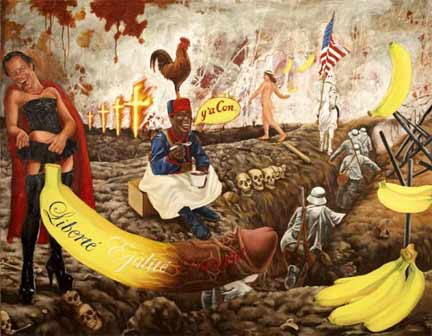
Ya con by Valentine
(Credit: Valentine)
“I need to separate doing my work from commenting on it” explains Valentine, rustling behind a plastic sheet, trying to hide from unexpected visitors and concentrate on her Banania series of paintings which take an ironic look at French history from a Martiniquais’ point of view.
Like many an artist she has to earn money elsewhere and works with children half the day and spends the rest here painting.
Now that the former squatters have to find their own accommodation, plus pay for running costs, some are also wary about added pressure to be commercial.
Jerome Duprat, who was not part of the 59Rivoli collective but often worked with them, says living for free in a squat can give you more freedom to be creative.
“If you don’t have pressure you can really develop, see where things take you,” he says. “I know people that have ended up painting vases of flowers just because they had to pay the rent.”
Deinki, however, seems to relish the chance to be a more established, paid-up artist.
“Ten years ago I thought my work was OK, but maybe others didn’t,” she says. “Now it’s better and I’m pleased to be able to sell. Some people here have families and kids. We’ve grown up”.
She also sees 59Rivoli as the fruit of a long battle.
“We fight for this result and we win. If it goes well, it will give hope for other squats,” she explains.
Paris City Hall has already rehabilitated squats like La Forge in the 20th arrondissement and Les Frigos’in the 13th, and has plans to continue with other squats.
But while 352 artists have benefitted from new workshops in Paris since 2001, it’s far from enough. Gaspard Delanoë says 10,000 artists are waiting for spaces in which to be creative.
In the meantime don’t hesitate to push open the door to 59Rivoli. It says "Welcome" on it… and you are!

Culture

Cracking skulls!
Fascination with death reaches new heights in an exhibition guaranteed to make you touch your head and feel thankful it is not made out of colouring crayons, or flies!
2010-02-15 12:35 TU

France's gothic avant-garde
A new show reveals an avant-garde Paris in the 13th century creating “total art” that spread from architecture to all art forms and went on to conquer much of Europe.
2010-02-13 15:16 TU

Winter sounds warm up French jazz fans
A tribute to trumpeter Don Cherry at a Free Jazz showcase festival outside of Paris.
2010-01-31 11:55 TU

Trance on a trapeze
Ever thought of running away with the circus? The mere idea sounds almost 19th century now, but the art of the circus is alive and well.
2010-01-30 12:41 TU
Retro Mobile - classic car exhibition

260,500 euros for rusty old car found at bottom of lake
A rusty old Bugatti, which spent years at the bottom of a Swiss lake, sold for 260,500 euros at the Retro Mobile classic car exhibition on Saturday. Other more lovingly-restored pristine examples are exciting enthusiasts from across the world in a special anniversary event at Porte de Versailles in Paris.
2010-01-23 20:21 TU

France's changing face looks east
Since its ethnically diverse team won a famous World Cup victory 11 years ago, France has tried to change its image at home and abroad. Bonjour India presents a multicultural French-speaking world to south Asians.
2010-01-22 16:17 TU

Putting art on film
International films about art converge in Paris for a festival at the Louvre from 20-24 January.
2010-01-20 13:09 TU

What sex is a coffee bean, where does the aubergine come from?
Where were eggplants first grown? And what about quinces and clementines. A new book traces the journey of fruit and veg from their countries of origin to our plates.
2010-01-08 16:08 TU

Cocteau Twin flying solo
In the 1980s and 90s, Robin Guthrie was the guitarist whose rippling layers of sound formed a pivotal part of the sound of the British band, the Cocteau Twins. His most recent solo work Songs to Help My Children Sleep was released in November.
2010-01-06 16:43 TU

A taste of Nordic filmmaking in Paris
Ciné Nordica 2009 at Paris’s Panthéon cinema showcases filmmaking from Scandinavia. So what makes Nordic film different from the rest?
2009-12-22 17:15 TU