



 |
China-Africa relations - interview
China’s relationship with Africa going strong
Article published on the 2009-10-01 Latest update 2009-10-01 11:01 TU
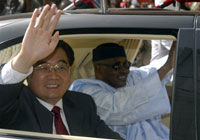
Chinese President Hu Jintao in Mali with President Amadou Toumani Touré at the start of his African tour in February, 2009
(Photo: AFP)
China has been replacing many western countries as the top trading and investment partner in many African countries, and for decades it has been one of Africa’s best friends, helping in the decolonisation process and building key infrastructure projects on the continent. Sixty years after the creation of the People’s Republic, as China becomes a global power, relations between it and Africa are growing stronger.
China is one of the oldest actors in Africa, explains Peter Kagwanja, director of the Africa Policy Institute in Pretoria, South Africa.
“What is new about China is its rise to global prominence, challenging Western hegemony and Western dominance,” he told RFI.
Analysis: Peter Kagwanja, Africa Policy Institute, Pretoria
“What is not known is how China is going to behave as a global power, whether it’s going to acquire the same imperial characteristics… or whether it’s going to be a humble power, the so-called gentle giant.”
The relationship has benefitted Africa, with China supporting many countries’ independence movements, and helping to build infrastructure.
“It’s a long, fulfilling relationship of economic and political engagement, and I think that is the check that China is now cashing in, in the new scramble for Africa,” he said.
While infrastructure projects benefit the continent, there is some resentment from African workers, as much of the labour is imported from China.
China’s rise to power has taken some African leaders by surprise, says Kagwanja, but the world’s poorest continent can learn a lot from China’s development.
“It is the one single country in recent times that has managed to pull so much of its population from the vagaries of poverty, into some level of decent living,” he said. “I think there are lessons to be learned from China on how to invest national resources in a way that you help pull the mass of the population out of poverty.”