

 |
Rwanda - Commonwealth
Rwanda becomes 54th member of the Commonwealth
Article published on the 2009-11-29 Latest update 2009-11-30 07:04 TU
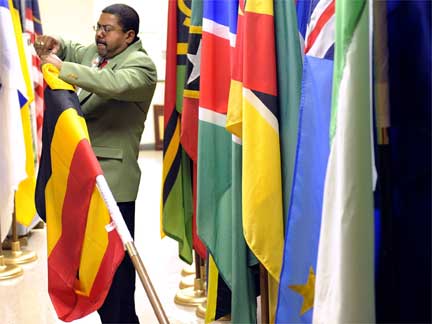
Officials will now need to make room for the Rwanda flag as well
(Photo: Reuters)
The central African country of Rwanda has become the second nation with no history of British colonisation to join the Commonwealth – an organisation for nations who used to belong to the British Empire.
The decision to allow Rwanda, a former colony of Germany and then Belgium, into the 53-nation club was made at the organisation’s summit which is currently being held in Trinidad and Tobago.
"My government sees this accession as recognition of the tremendous progress this country has made in the last 15 years," information minister Louise Mushikiwabo told London’s Sunday Times.
"Rwandans are ready to seize economic, political, cultural and other opportunities offered by the Commonwealth network," she added.
Rwanda’s admission was based on four grounds including democracy and democratic processes such as free and fair elections, rule of law and the independence of the judiciary, good governance including a well trained public service, and transparency.
The other aspects were the protection of human rights, freedom of expression and equal opportunity.
The Commonwealth Human Rights Initiative opposed Rwanda’s admittance. It said in a report in July that "the state of governance and human rights in Rwanda does not satisfy Commonwealth standards."
It also raised concerns about constraints on freedom of speech and political expression in Rwanda, which "created a climate of fear in civil society".
Rwanda was strongly backed, however, by Britain, Australia, Canada and India – the most influential countries in the group.
It also had the backing of Uganda, Kenya, Tanzania, South Africa and the host country Trinidad and Tobago, among others.
Canada argued that admission would help alleviate any concerns.
"The Commonwealth is well positioned to assist Rwanda in strengthening its democratic institutions," a spokesman for the Canadian foreign ministry told AFP.
Mozambique, which joined the Commonwealth in 1995, is the only other member country without a British past.
Richard Dowden, the Director of the Royal African Society, told RFI that membership could mean a reallignment in Rwanda's trading pattern.
"I think to Rwanda it's a very nice club to belong to," he says.
Analysis: Richard Dowden, Director, Royal African Society
"Most of all it is anglophone and the RPF government's bitterness towards France is still very strong and the best ally against France, as they see it, is Britain and the anglophone world.
"Economically, it (Rwanda) is going to be tied up with the anglophone East Africa rather than the francophone countries of West Africa."

Commonwealth summit