



 |
South Africa/Zulu - circumcision
Zulu king wants to bring circumcision back
Article published on the 2009-12-09 Latest update 2009-12-09 18:54 TU
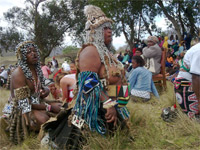
Zulu Sangomas (traditional practicioners) in South Africa
(Credit: Wikipedia/Wizzy)
The king of South Africa's Zulu people wantes to revive male circumcision in an effort to stem the spread of HIV-AIDS. Ritualised circumcision was common among Zulus until the beginning of the 19th century, when King Shaka halted the practice because it robbed him of young warriors for months at a time.
"In the contest of the fight against HIV and AIDS I should announce my intention to revive the practice of circumcision amongst young men," King Goodwill Zwelithini announced.
Authorities in South Africa's KwaZulu-Natal region are currently meeting with King Goodwill Zwelithini to discuss the possibility of reintroducing male circumcision.
Zwelithini is referring to studies made by the World Health Organization (WHO) that say that circumcising men can halve their chances of contracting the virus.
"What has been shown to occur in Africa is that men who are circumsized in order to prevent HIV believe they are immune to HIV and decrease their use of condoms, which increases their rate of infection," said Brian O'Donnell, a member of Intact America, and an HIV-AIDS specialist and Physican Associate.
"WHO and UN-AIDS are staffed by Americans with biases in support of circumcision and have disregarded the ethics involved in educating men about normal anatomy," he told RFI.
It was originally hypothesised in studies that circumcised men reduced the rates of infection if women were HIV-positive. "Then it was thought if the men were HIV-negative [and circumcised] then they would not transmit disease to women," said O'Donnell.
"Hoever, what has been found is that when men are circumcised and men become HIV-positive or are circumcised while they are HIV-positive, then the risk of transimitting it to an uninfected partner increases by 50 percent," he added.
"The efforts and money involved in trying to circumcise the rest of the men in Africa to prevent HIV infection could be better spent on other methods as well as giving money to funding anti-retrovirals for people are currently infected," he said.
Interview: Brian O'Donnell, Physican Associate and member of Intact America