

 |
Indonesia - Abdurrahman Wahid obituary
Who was Gus Dur?
by Tony Cross
Article published on the 2009-12-31 Latest update 2009-12-31 13:43 TU
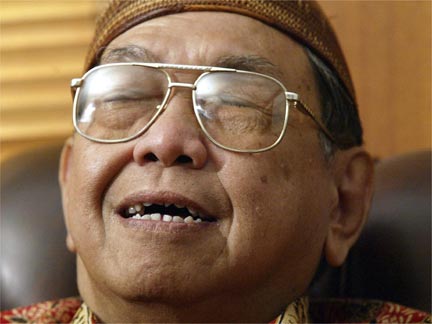
Abdurrahaman "Gus Dur" Wahid in 2004
(Photo: Reuters)
Abdurrahman Wahid, popularly known as "Gus Dur", was the first Indonesian President to be elected after the fall of General Suharto. He also headed the Nahdlatul Ulama, the country's largest Muslim organisation, which defended a traditional, tolerant form of Islam.
Wahid was admired for his broad-minded approach to religion and politics. But his presidency ended amid unproved charges of corruption. Afterwards support for the party he founded, the National Awakening Party (PKB), declined to only five per cent in the 2009 general election.
Here are the key dates in his life:
1940: Born in Jombang, East Java, to Abdul Wahid Hasyim and Siti Solichah, named after Abd ar-Rahman I of the Umayyad Caliphate, who took Islam to Spain.
1944: Family moves to the capital, Jakarta, where Abdul Wahid Hasyim was involved in the Masyumi Muslim organisation, set up by the Japanese when they occupied Indonesia.
1945: Family moves back to Jombang after the Indonesian Declaration of Independence. Independence war against the Dutch starts.
1949: Independence is won. Family moves to Jakarta, as Abdul Wahid Hasyim is appointed Religious Affairs Minister.
1963: Goes to Egypt, where he learns Arabic and studies at the world-famous Al-Azhar University in Cairo before taking a job at the Indonesian embassy, later moving to the University of Baghdad.
1967: General Suharto establishes military-dominated New Order regime after sidelining independence leader President Suharto.
1970: Studies at Leiden University, the Netherlands, travelling to Germany and France.
1971: Returms to Indonesia, contributing to Prisma magazine, then to Tempo and Kompas. Lectures at religious schools, known as pesanterans and madrassahs.
1977: Becomes Dean of the Faculty of Religious Beliefs at Hasyim Asyari University. Goes on to join the Religious Advisory Council of Nahdlatul Ulama (NU).
1982: In first political activity,campaigns for the United Development Party (PPP), an Islamic Party backed by NU, which went through an internal crisis leading to reform of the organisation.
1983: Persuades NU to accept Indonesia's official ideology of pancasila, which recognises four religions, and to withdraw from the PPP.
1984: Elected chairman of NU.
1985: Appointed a pancasila indoctrinator by Suharto.
1987: Appointed to parliament after criticising the PPP.
1989: Re-elected chairman of NU.
1990: Declines to join the Suharto-sponsored Union of Indonesian Intellectual Muslims (ICMI), accusing it of helping the regime and encouraging sectarianism. Forms the Democracy Forum, which suffers some official harasment.
1992: Legislative election. Police disrupt a Great Assembly in Jakarta to celebrate the NU's 66th anniversary. Encourages inter-faith dialogue.
1994: Accepts an invitation to visit Israel. NU National Congress re-elects him chairman. Moves closer to Suharto's daughter, Megawati Sukarnoputri, and her Democratic Party (PDI), later to become the Democratic Party of Struggle (PDIP).
1997: Asian financial crisis strengthens opposition to Suharto.
1998: Suffers stroke. Suharto re-elected for a seventh term as President. Student protests turn to riots. Calls for protests to stop after Suharto promises reform. Suharto resigns. PKB formed.
1999: PKB wins 12 per cent of the vote in general election and names Wahid its presidential candidate, who will be elected by parliament (MPR). Beats Megawati, whose PDIP has the largest number of MPs, thanks to the support of other Muslim parties and Suharto's Golkar. PDIP supporters riot. Megawati elected Vice-President. Wahid forms coalition cabinet, including military representatives.
2000: Forces former armed forces chief General Wiranto to resign from cabinet because of his implication in atrocities in East Timor and opposition to military reform. Dismisses Trade and Industry Minister Jusuf Kalla of Golkar and Sate-Owned Enterprises Minister Laksamana Sukardi of the PDIP. Begins negotiations with the separatest Aceh Freedom Movement (Gam). Declares marial law in Maluku to combat sectarian violence.
2001: Lifts ban on signs of Chinese culture. Opposition to him rises after two corruption scandals and a private declaration that he might have to dissolve parliament due to ethnic and religious violence in several regions. Faced with a movement to impeach him, orders Security Minister Susilo Bambang Yudhoyono to declare a state of emergency. Yudhoyono refuses. Wahid impeached and replaced by Megawati. PKB splits.
2004: PKB wins 10.6 per cent in legislative elections. Wahid nominated as its candidate in first-ever direct presidential election but fails the medical test. His brother Solahuddin stands along with Wiranto, their ticket coming third. Yudhoyono elected with Jusuf Kalla his Vice-President.
2009: PKB wins 4.9 per cent of the vote and 27 seats in parliamentary election. Yudhoyono re-elected President. Wahid dies on 30 December and is buried on 31 December.