

 |
Belgium - fatal train crash
Twenty feared dead in Belgian train crash
Article published on the 2010-02-15 Latest update 2010-02-15 16:00 TU
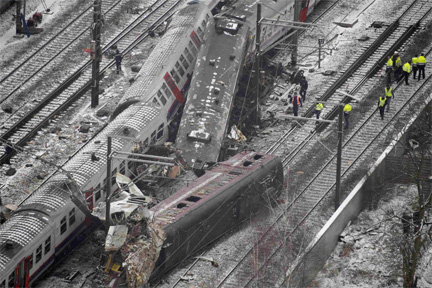
An aerial view of the fatal train crash near Brussels on 15 February, 2010
(Photo: Reuters)
At least 20 people are feared dead after two passenger trains crashed into each other outside Brussels during rush-hour Monday morning.
The trains collided head-on at about 8.30am at Halle, a Brussels suburb, about 15 kilometres south-west of the Belgian capital.
Halle’s mayor Dirk Pieters told a Flemish television station that “at least 20” people had died in the accident.
"All the emergency services are there. The most seriously injured are being treated at the scene before being taken to hospital," he said.
The Belgian secretary of state for mobility, Etienne Schouppe, said many people were badly injured and some would need amputations.
The national railway company SNCB was unable to confirm the number of dead, but a spokesperson for track operator Infrabel told the AFP news agency that police would put the figure at “at least a dozen”.
Infrabel said one of the trains was travelling from Quievrain to Liege, and the other was going from Leuven to Braine-le-Comte.
"A crowded commuter train on the 'down' line apparently failed to observe a closed signal and crossed to the 'up' line, where it immediately collided with another train," RFI's Quentin Dickinson reports from Brussels.
"The first two coaches of the 'down' train derailed, as debris flew across the track and wounded several passengers in yet a third train," he says.
The incident has caused major traffic disruption and the Thalys and Eurostar high-speed train services in and out of Brussels are also seriously disrupted.
This is the third high-profile rail crash in Belgium in the past decade. In 2001, eight people were killed and 12 were injured following a head-on collision between two passenger trains east of Brussels. It is thought that language difficulties between Flemish- and French-speaking colleagues contributed to that crash.
In 2008, more than 40 people were injured when a passenger train travelling in the wrong direction struck a freight train in the centre of the country.