
 |
  |

Khaled in the U.S.
The Algerian Raï King Tours the States
Los Angeles
06/03/2002 -
 It's 9pm on February 24th and we're standing on Broadway Avenue in downtown L.A., waiting to go backstage and meet Khaled before his show at the Orpheum Theater. This is the second of the Raï star's L.A. shows and the final date in his U.S. tour – so it comes as no surprise to find a huge crowd packed into the Orpheum listening to the support act, Hakim. But there's no mistake about it, the audience are there to see Khaled, the King of Raï. We find the Algerian superstar backstage, suffering from pre-show jitters – in fact, nerves have prevented him eating anything all day! Khaled nevertheless greets us with a smile and answers our questions with impressive frankness and honesty.
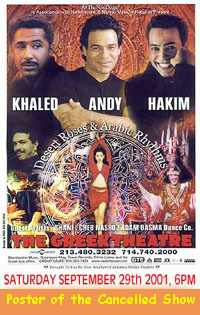
RFI/Musique: This concert – the final date in your current U.S. tour – was originally scheduled at the Greek Theater in Los Angeles in September 2001. Why did you decide to put it off until now?
Khaled: Well, obviously, we cancelled the September tour dates in the wake of the terrorist attacks on September 11th. I was afraid there'd be a lot of repercussions. Besides, I've never accepted the idea of performing in a country at a time of political upheaval. It's so radically opposed to what my music's about, to the message of peace and joy that I try to get across in my songs. It's for more or less the same reasons that I refused to perform in concert back home in Algeria for fifteen years. Following the attacks on September 11th we made a unanimous decision to put our U.S. tour back to a later date. It was a way of respecting the period of mourning for the loss of so many lives. Having this long period of waiting before coming out to the States really made me think about what I was trying to do in my music – and it also strengthened my desire to put a message of love across in my songs!
So where has your tour taken you in the States?
The tour kicked off at the beginning of February. But I actually flew out to the States a few days before my musicians to perform for heads of state who were taking part in an economic summit in New York. It was a pretty memorable occasion as I got to meet Quincy Jones and performed the John Lennon classic Imagine as a duet with Noa¹. It was a wonderful experience and something I still treasure, in fact. After that concert I hit the road with my musicians and we headed west playing dates in Washington, Detroit, Chicago and even Canada where we performed in Montreal and Toronto. We've been on the road for nearly a month now and Los Angeles is the last stop before we head back to France.
What kind of reaction have you had from American audiences this time round?
Well, it's been very different from the last time I performed in the States, when I did a concert in Central Park in 1993. The great thing about this tour is that we haven't just been getting the local Maghreb community in this time. The American public has really turned out in force and we've seen thousands of Americans dancing to Raï music. At times it felt like I was reliving the experience of playing my first concerts in France, in fact. 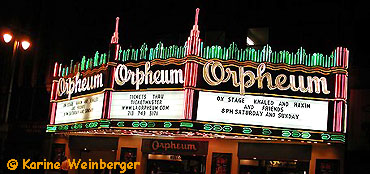
So now that you've won over French audiences, your plan is to set out and conquer the States?
No, I wouldn't say that. All I'm trying to do is show that music knows no borders. The interesting thing about America is that it's a country made up of an amazing mix of different cultures and racial origins. And I've always found it fascinating fusing different cultures together. To be honest, I can't afford to ignore such a huge market either – America's become the absolute Mecca of show-biz so it's not like you can bypass it or anything!
I think you can try and reverse the roles though. By that I mean instead of lying down and letting yourself be swamped in a wave of America's cultural exports, you can try and make your mark on their territory instead. I'm fed up with looking round and seeing France – and the rest of the world too, when it comes to that – roll out the red carpet every time some American rapper arrives. He doesn't even have to be a big star or anything, the simple fact of being American means he gets the red carpet treatment! I think it's time to turn the tables and prove that we've got talent worth exporting too. I see my personal quest in life as defending music around the world!
You've worked with a series of internationally renowned producers in the course of your career, collaborating with people like Don Was, Philippe Eidel and Michael Brook. Would you say that their input has played a vital role in your creative process?
Yes, definitely. I need to work with producers like them. They nurture my creativity. In fact, I don't think you can do without exterior input. You really need another pair of ears and eyes! It's very difficult for musicians to keep on coming up with something fresh and different, you know. Once you've got two or three hits behind you it's easy to fall into the trap of churning out the same old thing! I don't think it's even deliberate either, you do it without even being aware of it sometimes. That's why it's essential to work with good producers. And I've been lucky enough to work with some of the most talented guys in the business.
I chose to work with Don Was for a very precise reason – I got him in to work on the song Didi because I knew I wanted to come up with something very American sounding to win over French audiences. Didi went on to become a huge hit when it was released as a single in France and the French public took me to their hearts. Four years later I went on to work with Philippe Eidel. Philippe comes from Brittany originally but he's completely hooked on Oriental music. The result of our collaboration in the studio was Sahra - which I think is a really beautiful song. Every time I've worked with a new producer it's been really constructive, I feel like there's been an amazing process of interaction and exchange. When it comes down to it, we all speak the same universal language – and that's music!
Rachid Taha claimed in a recent interview that Raï has enjoyed its hour of glory and is now on the way out. What do you say to that?
I don't agree at all. Believe me, Raï music will always be around! Can you imagine rock'n'roll or reggae disappearing off the face of the earth? No, that would be impossible! Well, it's the same for Raï. Once a music exists, it's not that easy to get rid of it, you know.
I've spent a lot of my life travelling and that's brought me into contact with a lot of cultures. I think that's given me the ability to mix a lot of different things into my music without denaturing or distorting Raï in any way. It's a question of mixing in the right dose really. There are certain instruments, for instance, that would never work in my musical mix and as a musician you have to be aware of that. When it comes to respecting the essence of Raï the secret is knowing which instruments you can weave into the mix and which you can't.
Why did you wait fifteen years before agreeing to go back and perform in Algeria?
Well, the thing you've got to understand is that Raï is a festive, upbeat music. It's about spreading joy and happiness and having a good time! The reason I didn't want to go back and perform in Algeria was I didn't want to be seen as some sort of activist militating for a political cause. You have to remember that fifteen years ago in Algeria no one wanted to listen to Raï music – it was banned on every single radio and TV station at the time! It's different now. Raï's famous throughout the Maghreb and the Middle East. And I've become a sort of spokesperson for Raï despite myself, basically because I was the one who insisted on pushing our music beyond the borders and sharing it with the rest of the world.
What's the real message behind Raï music?
If I had to sum it up in a sentence it would be: Make love not war! Raï also expresses things about the family and everyday life. One thing's for sure, you'll never find a negative or aggressive message in Raï!  Raï was originally performed by female singers. But these days all the major stars like Faudel, Cheb Mami and yourself are men…
Yes, it's true, we must be a bit macho or something! If you look back two or three generations you'll find it was women who performed Raï, so the songs celebrated the male of the species, using all these elaborate metaphors. Things have swung round completely now. These days you've got male singers celebrating the glories of womankind. But it's the same thing. We never refer to a woman directly, we describe her through metaphors. That's the beauty of Raï music really, it's got a real sensuality to it and a powerful erotic charge. I've tried to modernise the genre too, seeking inspiration in new musical trends and paying attention to changes in public tastes.
What do you think of the term 'world music'?
I absolutely loathe it! I was already living in France when Peter Gabriel and co. came up with the concept. I think it's fair to acknowledge that back then the term 'world' helped singers like myself and Youssou N’Dour establish ourselves and gain acceptance on the international scene. But it's ridiculous to compartmentalise things like that – music belongs to the world, it knows no borders! Sometimes I get the impression they came up with the world concept as a sort of 'divide and conquer' policy, you know! Anyway, if you're going to talk about 'world' music you should include techno in there too, because techno originally comes from Morocco. But few people are aware of that because it's been exploited by British and American acts!
In the early days of my career in France I spent a lot of time wandering around record stores and I always found my albums stashed away in the 'world music' section. Then suddenly a few years later I started appearing in the 'French artists' category. It's all complete nonsense! If you want my opinion, the term 'world' was essentially dreamt up as a way of making money. It's a real shame these days, the show-biz system reigns supreme. Artists don't sing with their soul any more – they sing because they want instant success, fame and money! It really makes you ask yourself: where have all the Piafs and Brels of this world gone? What have we done to music?
Interview: Karine Weinberger
Translation: Julie Street
¹ at a private concert at the Waldorf Astoria (31 January 2002)