
 |
  |

Album review
CD of the week: Bernard Lavilliers
Older, Wiser, Calmer - But as Committed as Ever!
Paris
29/06/2001 -
 We caught up with the committed protest singer and hardened globe-trotter, pounding the docks of Boulogne-sur-Mer as a camera crew busied themselves with the making of the video for his new single. With his athletic boxer's silhouette outlined against the horizon, and just the slightest trace of stage make-up on his high cheekbones, Lavilliers appeared happy and relaxed to swap the Brazilian sunshine for the spray coming off the blustery North Sea. What's more, the dilapidated old factory standing in the distance makes the perfect setting for his new single, Les Mains d'or - a topical modern-day fable about industries downsizing, streamlining and relocating to other areas and laying off thousands of workers to boost shareholders' profits.
The plaintive chorus of Les Mains d'or "J'voudrais travailler / travailler encore / forger l'acier rouge avec mes mains d'or" ("I'd love to work/ work again/ forging the red steel with my golden hands") echoes off the walls of the dockside warehouses, accompanying the cries of the local seagulls. Rather than expressing rage and revolt at social injustice, as old-style Lavilliers songs might have done, the accordion, guitar and Gypsy violins fuse together to create a mournful, nostalgic melody line.
"I think the first stage workers go through on hearing they've been made redundant," explains Lavilliers, "is to feel this total resignation in the face of circumstance. Resignation is definitely the first reaction, before revolt. Tell a man he's out of work and he'll stand there completely dazed and confused, reeling as if someone's just punched him in the face. The feelings of injustice and revolt come later." Lavilliers has first-hand knowledge of the harsh world of factory work, having spent three years working as a metal turner in the St Etienne region before launching his singing career. 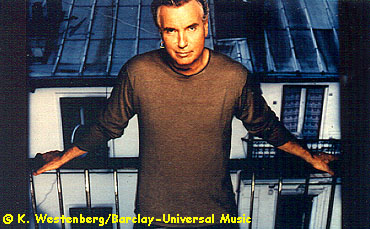
"Les Mains d'or is a song about people who've spent twenty years slogging their guts out in the same factory," says Lavillier, his blue eyes flashing, "and then one day someone turns around and utters those fateful words: "merger" or "downsizing". Before they know it, the workforce who've kept that factory running for twenty years of their life are out of a job. And suddenly they find themselves redundant, on the scrap heap, way past the age where they can retrain for other jobs. They're shell-shocked. They don't really understand what's happened to them. All they know is, they thought they'd be shown a bit more respect towards the end of their working life! Les Mains d'or is a song about human dignity and the basic right to work."
"The main character (in the video) is played by the actor Christophe Malavoy," explains Lavilliers, "I really admire the way he acts and I like the fact he's got a really strong, mature face and looks the part of the character. He doesn't look too rustic or anything. I didn't want him to look like a caricature of a hard down-trodden worker, just an ordinary guy."
The singer could have shot his new video against a backdrop of slagheaps, coal pits, factory chimneys and allotments. But he chose an empty dockside and a sea view instead. "I picked this spot (for the video) because it's related to my own personal history." the singer admits. "I reached a sort of crossroads in my life at one point where I had to choose between settling down to life as a factory worker or climbing on board a boat and getting the hell out of there. That's why I wanted the sea to feature in the video somewhere, just as it does on the new album. The sea's there as one of the elements, but it also has symbolic value. It represents danger, travel and dreams. It's like a sort of voodoo priestess watching over proceedings." 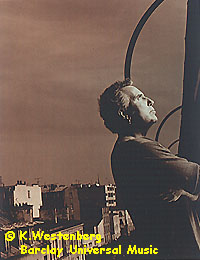 Wandering round the deserted warehouses and the abandoned hovercraft terminal where crowds of tourists used to queue for the crossing between Boulogne and the UK, Lavilliers came up with his idea for a radical reworking of the Prevert and Kosma classic les Feuilles mortes (Autumn leaves). Lavilliers's salsa version of the song is even more daring than Yuri Buenaventura's recent salsa reworking of Jacques Brel's Ne me quitte pas.
"I went for a traditional-style salsa (on Les Feuilles mortes)" says Lavilliers. "But the brass section is a lot closer to New York jazz than it is to Cuban influences. Basically, I thought it was a shame you didn't get to hear the song played so much these days - and I figured I could do with recording a bit of a love song as my repertoire's a bit lacking in that department," adds the singer with a laugh. "I particularly liked the image of the sea in les Feuilles mortes where it sweeps up onto the sand and wipes out the footprints of the old lovers. I think that's the single most beautiful image in the entire song."
Nostalgia is also the order of the day on L'Empire du milieu, a slow rock number whose tongue-in-cheek lyrics take an ironic look at the singer's petty criminal past. "For me, L'Empire du milieu is a sort of setting the record straight, the end of an era," explains Lavilliers, "But you shouldn't take the lyrics at face value - there's a second or even third level of meaning going on there. Basically, I'm poking fun at a particular period of my life, an experience that other people won't have shared. I used to hang out with these guys who'd left the criminal underworld and completely retired from their life of crime, but everything they did was still pervaded by their earlier lives. They still used all the old wit and bandit slang, they still had all their old names like Auguste Le Breton and Beau Torse. Believe me, I've experienced some quite extraordinary get-togethers in my time where everyone sat round spouting dialogue straight out of "Les Tontons flingueurs"(a famous French cops-and-robbers comedy)."
Older, wiser and obviously a great deal calmer, Bernard Lavilliers has lost none of his musical touch. And better still, his new marks a return to his use of infectious Brazilian rhythms and melodies. The singer, who left Fortaleza in northern Brazil to hit the road again, took two years between touring and songwriting to record his new album and, like a good wine, ArrÙt sur Image, is all the better for that period of maturation.
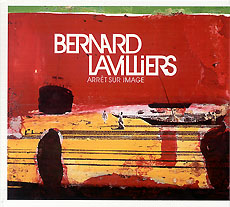
Bernard Lavilliers Arrêt sur image (Barclay / Universal)
Frédéric Garat
15/10/2004 -
28/03/2003 -
20/03/2003 -