
 |
  |

Lavilliers touring the Americas
The man from St Etienne is on the road again
Port-au-Prince, Haiti
20/03/2003 -

"I know poetry is difficult to translate, just like music... you feel it. But I'm asking you to enter into the spirit of the Alliance Française whose vocation is to teach French here. I ask those of you who understand to try and translate what I'm saying and particularly what I'm singing" says Bernard Lavilliers as he goes on stage. With his huge, impressive frame, tight leather trousers and the habitual gold earring in his right ear, Lavilliers began his Americas tour with this humble plea during his first concert on the eastern part of the island of Hispaniola. Today named the Dominican Republic, it is therefore totally hispanophone and no more than half of the 1,400 or so in the audience could understand his lyrics. That didn't stop the whole hall being quickly won over by the few words of portugnol (a mix of Portuguese, slang and Spanish) which the singer managed to jabber between songs. Before long the public were well into the rhythms and melodies of San Salvador, La Salsa, Mains d’Or or O Gringo.
Addicted to travelling
Drawing on salsa, bossa-nova, rock or reggae, Lavilliers lines up mythic songs in such a relaxed and generous way, he immediately strikes a chord with audiences. Not hesitating to push his way through the crowd and get people singing along to "So O gringo qui nao fala brasilero", Lavilliers soon heated up the Teatro la Fiesta hall at the Jaragua hotel - the biggest in town and in normal circumstances the coolest. Passing through the casino to reach the Teatro, spectactors left the cheap jingling of casino chips and roulette wheels for the vocal riches of Mon Gestionnaire, El Fuego and the recent hit Les Mains d’Or, a tribute to the dignity of laid-off factory workers.
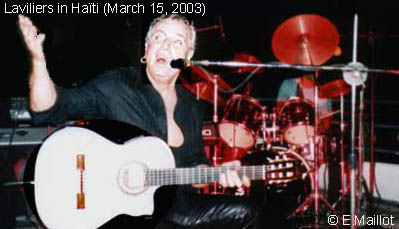
The young Dominican singer, Pavel, who performs just before Lavilliers, agreed : "Je vais t' applataniser, c’est-à-dire te rendre banane plantain, te rendre dominicain" ("I’m going to turn you in to a plantain banana, and make you Dominican") he cried, laughing. And that is precisely the goal of this tour organised by the Alliances Française, under the initiative of Olivier Pellenard, vice-president of the Washington branch: to popularise the poetry and songs of France, as well as encouraging meetings and cultural exchanges between French and foreign musicians. The aim being for artists to adapt to different places with their respective musical customs, even if it means that the kilowatts, lighting and electrical capacity of the Palais des Sports and other French venues which host Bernard Lavilliers, are not always available here: "I would say we’re talking about a "root music and back to the roots" tour here, and we’re going back to the kind of rock band we were twenty years ago, ready to play at all costs." added Bernard, stuck at the border between Haiti and the Dominican Republic, while patiently waiting for all the necessary bureaucracy to be completed.
Amongst the cries of children, the piles of brightly-coloured clothes, groups of beggars and military officers sitting around a game of dominoes with a local merengue in the background, the singer continued: " I think an artist owes it to himself from time to time to put himself in this kind of situation to touch base again. We couldn’t do it all the time, because technology is evolving, and we really appreciate playing in very good conditions, but at least here you can recharge your batteries."
In Haiti: "It’s really touching to be here".
With four musicians and one technician, Lavilliers'team for the Americas tour is surviving on a quarter of the usual number of staff. "Every little thing counts", grinned Lavilliers, "The singer can’t drink 'til four in the morning, the musicians can’t be ill... It’s a challenge every day..." After having negotiated the notorious border between the Dominican Republic, which is in full development, and the Haitian no man's land, the Lavilliers bus set off again to tackle the hills of Port-au-Prince. It’s been almost fifteen years since Bernard mobilised the crowds of this almost-forgotten country, whose economic situation virtually obliterates the memory of its cultural wealth. "It’s really touching to be here" He confessed "The first time I came here, nobody thought it possible to record. Thanks to a journalist friend at radio Métropole and the Widmaer broth".
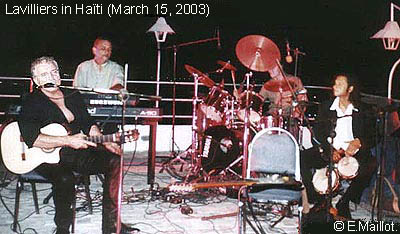
As in the Dominican Republic, Lavilliers embarked upon Sertao : "Le temps s’est arrêté en plein midi, il y a déjà longtemps (...) un soleil ivre de rage tourne dans le ciel et dévore le paysage de terre et de sel." There is strange echo of Brazil here in the Haitian capital,which has been ravaged by the economic crisis. "Haïtians are all Brazilians" explained a spectator. "Je I know that in listening to this track, the Haitians understand it. Bernard insists: "If you look at the bare landscape and the starkness of life in general, it’s the same. Everything gets lumped together: drought-induced violence, violence due to hunger, intellectual poverty, cultural riches, rebellion... these people know what I’m talking about."
After having stayed up late again to listen to Tikoka, Haitian troubadours, then the band Boukman Experience who mix voodoo, reggae and root-music, Lavilliers prepared himself to tackle other familiar destinations: Nicaragua on 17 March and Jamaica on the19th then the United States, where the current nature of Franco-American relations could have particular ramifications for this tour with the war with Irak going on in the background.
To be continued next week on the RFI Music website.
Next dates in the tour of the Americas:
21 : Miami, Florida.
22 : Atlanta, Georgia.
24 : New Orleans, Louisiana.
25 : Denver, Colorado.
27 : Vancouver, Canada.
29 : Montreal, Quebec.
31 : Panama.
2 April : San Salvador.
4 : Caracas, Venezuela.
5 : Maracaibo, Venezuela.
7 : Port Of Spain, Trinidad.
10 : New York.
Translation : Caroline Preller



28/03/2003 -
29/06/2001 -