
 |
  |

Album review
Souad Massi
Souad the dissident
Paris
28/03/2003 -
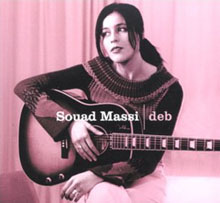 RFI : Your new album Deb is so eclectic that there's a bit of everything in there: Zairian rumba, zouk, flamenco, Arabic-Andalusian music, even Cat Stevens...
Souad Massi : I grew up steeped in Eastern African Arabic music and was also listening to a lot of western rhythms. I probably owe my being able to express myself now to that crossover.
RFI : As on your first album Raoui, the lyrics are very sad. But not the music. Is there always this contrast with you?
S.M: Its even sadder than the first one, isn't it ?
RFI : Maybe its because you've been gone for even longer now?
S.M : Some of these songs were written years ago. But I also composed some new ones in France. The reason for the sadness is that I've been through some pretty difficult times. But I hope that one day I will be able to write more cheerful songs.
RFI : It has to be said that the situation in the country where you spent the first 27 years of your life has not improved much.
S.M : Its not getting any better. In fact its getting worse. On this album, for example, Houria is about a woman and at the same time about Algeria. Its true that there is both fear and hope, its very ambiguous. I'm always being asked: "Do you have any hope for Algeria?" And I just don't know what to answer anymore. One day hope suddenly appears and the next it disappears just as quickly. Everything is so uncertain, in Algeria you live from day to day. Hence Houria which means "freedom".
And there's also the song Le bien et le mal. The situation in Algeria is similar to the situation in a lot of countries. I'm very pessimistic about what's happening in the world, especially at the moment with the war in Iraq. Then there's the Arab-Israeli conflict which has been dragging on for years. I'm so disappointed, I think to myself: what's the point in us going into space to explore when we can't even manage to love each other here, to find solutions to our problems, we don't seem to be getting anywhere. And its always the innocent who end up paying. I don't believe in clean wars and surgical strikes, there's no such thing.
S.M : We were in the studio and it came about quite spontaneously. My drummer is a Jamaican from London, he speaks in English a lot and we thought it would be interesting to send a message which would be understood by everyone. With everything that's going on at the moment, its obvious that its very hard to communicate. That was the idea behind the song: communication.
RFI : But there is a real tenderness in the song, even if the theme is solitude.
S.M : Yes, because I'm in the process of dealing with all that I lived through for many long years over there. With this song, I was still an adolescent, I was young. With Moudja,Deb, its the same thing, they were written back around the same time. The only songs which were written recently are Ya kelbi andPasse le temps. I already had all the lyrics, the music, even the arrangements. There is a huge void in Algeria, a great boredom. For me, it allowed me to travel in my head, to escape. I had time, I loved music and together with my two brothers I was constantly making music at home. The arrangements for Deb were in my head for a long time. The tabla, the sitar... it was all already written. I use very basic chords because I don't know the complicated ones. I write music in a very simple way.
RFI : Women are central to your lyrics, but there is one song written from a man's point of view: Yemma.
S.M : Its true, I sing about myself, but I also sing about people I meet who share their stories with me. Most were boys I met in England, students who described their daily life to me. But those I met elsewhere had practically the same story to tell.
RFI : When we talk to our mother on the phone we always tell her everything is fine, even if its a lie ?
S.M : We don't want to hurt the people who love us. We want to protect them. If its only a little white lie, its not important. But I detest lies, I'm a very direct person. Sometimes a bit too direct, it can sometimes hurt people.
RFI : There's also some Zairian rumba ?
S.M : The Guyanese bassist who plays on Yawlidi certainly adds some colour. But there's also the bendir which keeps us in North Africa. Its good to be able to mix different musical cultures like that.
S.M : No. I sing about the elections, the people in power. I denounce those who are trying to cheat us and who will go to any lengths to win the elections. The song is all about them.
RFI :Le bien et le malwas inspired by a visit to Bab el oued after the tragic floods ?
S.M : I wrote it before I went, as soon as I saw the terrifying images on the TV. I felt terrible for all those who died. The images were horrific.
RFI : You studied to be a town-planner, it must be difficult for you to see a country where nothing is being built ?
S.M : No, there are some beautiful villas being constructed! No, I can’t agree with you there. When I was there I saw castles, beautiful palaces. They are being built for the elite. To celebrate the "Année de l'Algérie", but there's a lot of hypocrisy involved. I wouldn't like to be in the shoes of the people who live there: they sit bored in front of their TV sets because there's nothing interesting to watch, the cost of living is ridiculously high; not to mention the daily power cuts and water shortages. I don't know how they do it. Its as if there is a desire to starve the people, so that the only thing they will worry about is food. You can be as creative as you like but you'll always be held back by bureaucracy, bad management, corruption...
RFI : The pearl of the album is hidden right at the end...
S.M : I'm really happy with that, the music on Beb el mahdi is so beautiful. It really swings. Its about a lot of different friendships which I've grouped into one. The image of meeting someone you like a lot and then it all breaks down and that same person crosses the street to avoid you, its a very hard thing to go through.
S.M : When the first album came out, I was terrified. I couldn't listen to it, I felt really terrible. But with this second album, I'm quite happy listening to it, in fact I really enjoy listening to it, I'm not so worried as I was before.
RFI: Do you think France is more racially mixed, more "Arabic" today from a cultural, culinary etc. point of view ?
S.M : As far as culture is concerned, you don't see many Arab or black people on the TV, and yet so many Arabs and blacks watch the TV without ever seeing themselves reflected there. I'm glad that so many Algerian doctors and great teachers are in France but its a pity that their reason for being here is that they can't practice at home. Then you have so many North Africans who are successful but who we never hear about, when people talk about Arabs its always the same image of a group of young kids in the estates hanging about in the stairwells. No one ever talks about the North Africans who become judges or lawyers or even researchers or philosophers. The first time I saw a North African philosopher I was delighted. You don't hear about these people, its not interesting enough, not commercial enough, it doesn't help the TV ratings.
Gérard Bar-David
SOUAD MASSI new album «Deb» AZ (dist. Universal)
IN THE STUDIO WITH SOUAD IN BRUSSELS
In the studio, an Indian tabla player stands beside Souad. "I wanted to bring a touch of India to the album. I got the idea from an Arabic expression I love: when you ask someone to do something for you and he takes an eternity to come back, you say to him "I didn't ask you to go all the way to India!" When I was living in Algeria, I wanted to go somewhere far away and the most far away place I could think of at the time was India!" The tabla player says to her, laughing : "Coming from India, the most far away place for me is Algeria!"
Tones of India... and many other influences take us on a voyage across the continents, cellos, lutes, and African flutes... Souad's voice recalls the voice of Latifa Raafat, one of the greats of the eastern world or more precisely of Moroccan Chaabi... Souad sings with delicacy and purity; above and beyond which she has the power to convey her emotions across the language barrier.
Souad is not exactly a workaholic. She even confesses to not working on her voice as much as she should. But could this just be false modesty from a singer who hits perfect chords? Along with her producer, her manager Abdel, and all her musicians, Souad Massi has created a touching, passionate and powerful album. It could well be that the key to Souad's talent lies in her playful and relaxed attitude to her passion. Its all so far removed from preformatted marketing formulas. And maybe the key to her second album lies in the words which she murmurs with a smile on her lips: "My real discipline is life!".
Mehdi Abid
Translation : Michèle Brady



25/11/2005 -
04/05/2001 -