
 |
  |

Twenty Years of Raï in France
The Rise of Raï since the first French festival in 1986
Paris
24/01/2006 -
"The atmosphere was just electric," declares Michel Levy, an independent producer who manages Raï star Cheb Mami, remembering that fateful date in January 1986. "The audience was mostly made up of Algerian immigrants. And, for the very first time in France, they were getting to touch base with part of their own culture. People had turned out from all over Europe to see these stars they knew from back home live on stage for the first time!" 23 January 1986 was not only a historic date in terms of being the first Raï festival organised on French soil, it also marked a deep-rooted change in attitude and a total upheaval on the music scene.
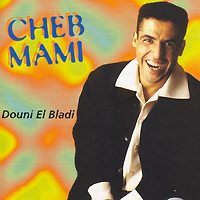
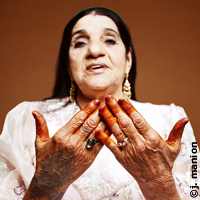
"The Bobigny festival was like this total cultural UFO which arrived out of the blue from Algeria with singers vaunting the joys of sex, alcohol and women," continues Michel Levy, who went on to become known as Monsieur Raï in France. For three whole days and nights, the 'crème de la crème' of the Raï world took to the stage, sending the largely community crowd into paroxysms of delight. The all-star line-up surpassed everyone's dreams, featuring everyone from Cheb Khaled and Cheb Mami and the feisty 'grandmother' of Raï, Cheikha Rimitti, to wild couple Sahraoui and Fadéla, the 'nightingale' Cheb Hamid and Raïna Raï, the original precursors of the modern Raï movement. The festival, organised by legendary French 'world music' pioneer Martin Messonnier, received coverage in the French press and marked the very first time in history that Raï had been recognised outside the Maghreb.
While Raï won mainstream cultural legitimacy in France, back home on the streets of Algeria it was seen as an anti-establishment force. With its risqué subject matter and its street lyrics sung in Arab dialect, Raï thrived on the margins of society. Journalist Bouziane Daoudi, who has written a number of books about Raï, says "You have to remember that the authorities in place at the time revolved around a one-party system, the FLN, which imposed a blanket Arab-Muslim culture on the population. Raï was completely marginalised under this system and received no airplay on radio or television. You could only listen to Raï if you went out and bought cassettes in the souk or attended performances in certain cabarets in Oran. With its port opening onto the rest of the world, Oran was a much more 'libertine' kind of place than the capital, Algiers."
Wild and Unbridled Arab Sounds
Following the groundbreaking festival in Bobigny, talent scout Michel Levy realised Raï's enormous potential in France and engineered the recording of Cheb Mami and Cheb Khaled's first two vinyls. He proceeded to do the rounds of radio stations and record labels, convinced that this modern Arab mix of velvet vocals, synthesisers and electric guitars, could take off in France. However, post-Bobigny, the French media appeared to have got cold feet and seemed to be afraid of shocking its readers with this wild new unbridled Arab sound a million miles from the classical 'Oriental' canon.
Raï enjoyed a surge of popularity in France at a grass roots level, however, cassettes selling like hotcakes in Barbès ( a multi-cultural neighbourhood in Paris), as well as Lyons and Marseilles. "There was this whole parallel cultural life happening in the ghetto," remembers Michel Levy, "When trendy French people or those who were curious about new music wanted to get hold of Raï, they went up to the corner stores in Barbès, not the big record shops. Despite the fact there was no media coverage of the Raï movement, there was a major market out there!"
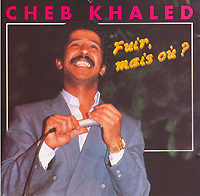
Over ensuing years, thanks to the excitement generated by word-of-mouth buzz, Raï gradually made its way into mainstream record stores. And in 1992, Cheb Khaled, a 32-year-old singer from Oran, exploded into the French Top 50 with his mega-hit, Didi - going down in history as the first Arab singer to chart in France! According to Michel Levy, the international success of Didi (actually a cover of a poplar song, not Khaled's own work) was totally fabricated by Khaled's record label Polygram. "Back then, record sales weren't calculated the same way they are now," Levy explains, "Instead of counting the actual number of copies sold at tills, figures were based on the number of copies a label got into the stores. Polygram pulled off a master coup, flooding stores with over 20,000 copies of Didi. And as a result, Khaled ratcheted his way up the French charts."
Didi's chart success may have been built on the back of a major label's clever marketing ploy, but there was no denying that Khaled's single helped Raï acquire a new international dimension – and there was no going back from there! The unstoppable rise of Raï was also aided and abetted by French socialist minister Jack Lang who was keen to promote the idea of France as a multi-cultural nation. Meanwhile, 'les beurs' (second-generation Arab immigrants who had been born and grown up in France) began to identify with the Raï movement, which they had originally dismissed as boring old music from the old country.
Cheb Hasni Gunned Down on his Doorstep
As Raï continued its unstoppable rise, a new generation of chebs and chebas emerged on the scene, promoting their own takes on the sound in the form of "Raï-trab" (an interesting regional variation), Raï-love and pop-Raï. Raï, a musical movement of Bedouin origin which had evolved thanks to female singers in the 1920s, became all the rage in Paris. But meanwhile, back on the other side of the Mediterranean, Algeria found itself in the throes of a bloody civil war. On 4 September 1994, the Algerian music world suffered its first casualty when Raï singer Cheb Hasni was gunned down by a fundamentalist in his home neighbourhood in Oran. The French-speaking Algerian newspaper Le Matin reeled in shock, under the headline "Singer of Love Falls Victim to Hate." Journalist Bouziane Daoudi recalls how at that time "Artists and intellectuals in general were all under threat. The fact that Cheb Hasni was gunned down on his own doorstep triggered a mass cultural exodus. The day after the tragedy, Sahraoui and Fadéla left Algeria straightaway."
 |
 |
Today, a full two decades after arriving in France, the Algerian phenomenon is still going strong – and Raï now looks set to develop even further. As Michel Levy points out, "In years to come, Raï will go on to become a revised and recomposed music that will still be called the same, but have nothing to do with what went before because the social and cultural parameters will have changed." All we can say is, we'll be back to report on new-look Raï in another twenty years!
Daniel Lieuze



15/12/2005 -
28/10/2004 -
17/09/2004 -
14/01/2002 -
24/12/2001 -
10/06/2001 -
04/04/2000 -