
 |
  |

Aïwa go global
El Nar's cosmopolitan mix
Paris
05/04/2006 -
 |
 |
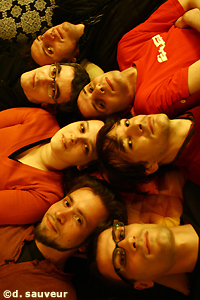
So fast was Aïwa's lightning rise to notoriety on the live front that Wamid, the group's loquacious bass-player, admits that the group had not quite got into their stride. "Back then we were still trying things out, attempting to hit on the right musical formula," he says, "We had two DJs at the time which was actually too much. We were also working with a VJ and using a lot of visuals as part of the live act. Then there was the question of the drums, which were systematically doubled up by machines. After trying a few different things out, however, we finally went back to a much simpler way of expressing ourselves." Even at this early embryonic stage, Aïwa's effervescent mix caught the attention of record producers and the Canadian label, Wikkid Records, offered the group a deal. (Rare for the record industry, this was a gentleman's agreement, with both sides giving their word of honour).
Following the release of a debut album on Wikkid Records, Aïwa shifted back into top gear, playing some 100 gigs on the live circuit between 2003 and 2004. These included appearances in Prague, Budapest, the U.K. and Italy. But when it came to recording their follow-up album, El Nar, Aïwa slowed the pace right down and gave up touring to concentrate on honing their new material to perfection. Meanwhile, after a few changes of line-up, the group finally stabilised to a regular seven members: one DJ, a flautist, and two singers accompanying the core trio of guitar, bass and drums. This time round, Aïwa took an entirely different approach to recording. "Our first album was like a snapshot of our live repertoire," explains Wamid, "But this time we actually learnt to compose music to listen to on a CD. We spent three months making demos of 15 songs before we finally went into the studio and worked on things for another two and a half weeks."
Looking to the East
Producing an hour of what can only be described as sheer musical intensity in just under 20 days is a major feat in itself. And Aïwa's fascinating fusion is impressively wide-ranging, moving freely from the Portishead-sounding strains of Ibn Sina and the Algiers ragga beats of Madness to an unexpected jazz interlude on Entronic. The group are not afraid of abandoning hi-tech machines on some tracks, either, and this results in some pure acoustic gems. What's more, despite the overall eclecticism the tracks on El Nar stream seamlessly into one another thanks to rapper Naufalle's captivating flow and singer Séverine's innovative vocals.
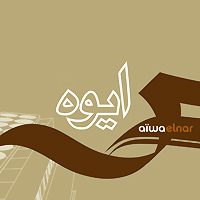
The title track El Nar, on which Aïwa manage to keep several different musical balls in the air at once, juggling dub hip hop and a full-on soul chorus, is a perfect example of the album's global fusion feel. Wamid confirms that "This was the very first track we wrote. For us, it's the perfect symbol of the balance we finally came up with. 'El nar' is an Arabic word meaning 'fire', but it's also used to describe a wild night out. From there it's come to be used as one of the words for hell. And our song talks about the constant suffering of a people faced with an endless series of crises, wars and embargoes." It does not take too much imagination to link the song to Iraq, the homeland of Aïwa's two founders, Wamid and Naufalle.
Launch the former on the subject of his homeland and there is literally no stopping him. Wamid describes how he was born in Iraq, but came to France as a result of his father's passion for all things French. "My father was a committed Francophile," he says, "and he was absolutely set on the idea of coming to France to continue his studies. We left Iraq when I was three years old. My family only intended to stay in France a few years to begin with, but in the late 70s the situation back home started deteriorating and things rapidly got worse. I haven't been back to Iraq for twenty years now. I'm still in touch with members of the family over there, but even they've warned us against going back. One thing's for sure and that is that if I'd stayed in Iraq, my life wouldn't be the same today!"
Big in the U.K.
 |
|
Ludovic Basque
Translation : Julie Street