
 |
  |

Bassekou Kouyate modernises the ngoni
He Speaks Fula
Paris
05/11/2009 -
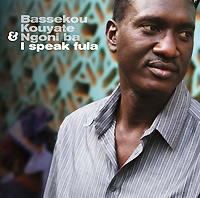
Bassekou Kouyate: The ngoni is an ancient instrument that was used way back when in traditional Griot storytelling. Our parents' generation never promoted the ngoni, though, they never tried to get the instrument known on an international scale. So young people started abandoning the ngoni and taking up other instruments instead. I've travelled a lot in my life, touring and stuff, and I could see that the ngoni had a lot of potential. I came up with the idea of putting together my own ngoni ensemble based on four ngoni-players performing with a calabash and a yabara (a small percussion rattle made out of a gourd.) I wanted the four ngonis to play in different registers. So I started by customising my own bass version of the ngoni to use in place of bass guitar because there was no such thing as a bass ngoni before I came along. Then I created a medium-toned ngoni and a ngoni to play the solo parts. The fourth ngoni basically serves to reinforce the bass and the medium ngonis.
Why did you wait so long to form Ngoni Ba? You all had decades of experience as musicians…
Well, it's not that easy getting a solo career off the ground. I took my time over things, building up experience bit by bit. I started out playing with my mother (the praise singer) Yagaré Damba, stepping in to replace my father - a famous ngoni player in his own right - when he was ill. After that I moved to Bamako where I accompanied some of Mali's top female singers and then I went on to make nine CDs with the kora-player Toumani Diabaté. My first trip to Europe was with Toumani and Habib Koite. We had our own group together. I went on to work with Taj Mahal, Dee Dee Bridgewater, Damon Albarn, Youssou N’Dour and Ali Farka Touré… It was when Ali died that I decided the time had come to form my own ngoni band.
What role did Ali Farka Touré play in your career?
Whenever I went to see Ali he'd reach out, take my hand and tell me it was a "black diamond." He'd ask me what I was waiting for, why didn't I branch out and do my own thing? Ali insisted that I couldn't spend my life accompanying others. He was an old man who spoke his mind and who was always very generous with us youngsters. Anyway, one day I was driving home when the phone rang and it was Ali's producer, Nick Gold. He told me he was in Bamako and that Ali needed me in the studio the next morning. I had to be at Studio Bogolan at 10 o'clock sharp! So I turned up there with my ngoni and Ali told me to sit down. The next minute someone put a microphone in front of me. Ali picked up his guitar and two minutes later shouted "OK, let's roll!" Two minutes' rehearsal and we went straight into recording the album Savane!
There's a famous legend associated with the balafon which dates back to the days of the Mande empire, but what's the story behind the ngoni?
The story of the ngoni was never officially written down. All we know is what our parents told us. Legend has it that one of my ancestors was walking along the banks of the Niger River when he saw a young woman sitting there playing the ngoni. When she stopped playing he applauded and told her he thought it was a beautiful instrument with a wonderful sound. The woman gave him the instrument, telling him that if he mastered it he would earn a living from it and later his children and his grandchildren would, too. My ancestor took the instrument but the moment he started playing it the woman disappeared. Back in the days of the Ghana empire - before white people arrived in Africa - musicians used to play the ngoni for the king, Djabé Cissé. The kora and the balafon emerged at a later date. Our ancestors reserved the ngoni for royal performances. You had to be a king or a great warrior to listen to ngoni music.
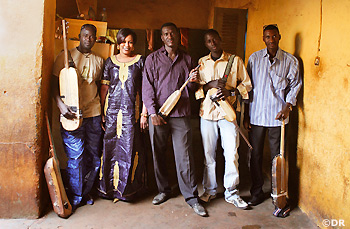
You're reputed to have been the first musician to modernise the ngoni by playing the instrument standing up…
Back around 1980, the singer Naïny Diabaté was invited to perform on a Malian TV programme and she asked the musicians from the Rail Band to accompany her. All the guitarists, including Djelimady Tounkara, were up front with their guitars. I was the only one left sitting behind on my own. So I jumped up, ripped open one of the inner tubes, attached it to the two ends of the ngoni with a couple of drawing pins and I slung the ngoni round my neck. When the other musicians turned round and asked me what I was up to, I told them I was going to play standing up like them. And since then, that's the way everyone's played the ngoni, standing up!
You were recently decorated by the President of the Malian Republic. What did that mean to you?
Becoming a Knight of the National Order of Mali is a pretty big deal. It places a certain responsibility on your shoulders, too, because wherever you go you act as an ambassador for your country. When my debut album Segu Blue won two BBC Awards, including Best African Artist in 2008, it showed young musicians in Mali that they could do something with the ngoni instead of taking up the guitar. That was a very important moment in my life because I felt as though I'd saved an instrument from extinction!
Torin Torin
Tour dates in Germany: 6 - 9 November 2009
Bertrand Lavaine
Translation : Julie Street
07/08/2009 -
12/09/2008 -
22/02/2006 -