
 |
  |

Album review
Pierre Akendengué
Album and African Tour
Paris
29/03/2002 -
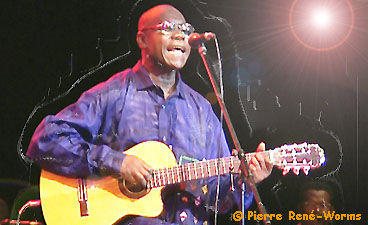
At this hour when the old hand at Gabonese music is preparing a tour of the French Cultural Centres in Africa, let's look back on his latest CD Obakadences. A bright album on which he remains faithful to panafricanism of the grand old days and shows himself more then ever to be a destroyer of the world's sins. Here the musician extols a most inspired musical syncretism, with a strong fondness for the sounds of the black world. Interview.
RFI musique:
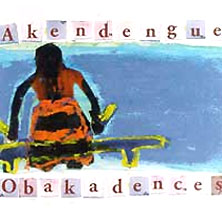 Obakadences sounds like a concept. What does this title mean?
Pierre Akendengué: The obaka is a musical instrument in Gabon, my homeland. It's a rack made of wood which you hit with two sticks. And this instrument's role is to link together two or more drums, in other words to harmonise. Very often, one pays attention to the drums and especially to the soloists, but we never pay attention to this little instrument that serves as a "bridge". I wanted to increase its standing through this record. At the same time, it's an analogy here. The obaka corresponds to what I do in music. From the beginning, my wish as an artist was to unite everyone. I always wrote songs in favour of African unity and also in favour of a permanent/constant dialogue between cultures, the only way according to me to reach out to the world. The song as a "talking place" ?
Every artist dreams of communing with the world. But communing often, means to reach out with the voice, the first instrument available to humans, towards the others because this(the voice) allows people to hook up and to become closer. That is why the lyrics are essential for us Africans. It makes the village, it founds the exchanges and takes root in the body like a child. But these are essential things that we sometimes forget like we forget the role of the obaka, this little wooden rack that links the drums. To sing is to carry the word that unites and that makes us more human. It's an indispensable component in the life of the community. An album that brings us the most contemporary rhythms such as the rumba to traditions that go all the way back to ancient Africa?
To summarize, I would say that it's a voyage across all of Africa. Across the entire Black-African musical world. The key word here too remains that notion of the bridge between the generations. From one song to another, there are reminiscences, veiled messages, reminders. An album which takes up with Pierre the pan-Africanist more than ever?
It's a part of me. I am a convinced pan-Africanist. I think, and I am not the only one, that Africa or the Africans will only be able to make it through integration. Each one of us has to contribute to this in his capacity. I personally do songs and I will never get tired of calling for integration.
Aren't you sometimes frustrated singing about an Africa that is incessantly sinking. Yes. The frustration is there. But what do you want?
An artist spends his time observing the movements in our society. In what he sees there is happiness and sadness, moments of joy and atrocities, pleasure and injustice and his role is to offer a dream to put the world right. A dream of beauty, liberty, equality, by hoping that this dream can become reality. Now, there are the deciders who are often politicians. I say "often" because there are not only politicians. There is us as well, the civilian society as we say. But on the front lines are the politicians. The artist can only encourage one to dream, it's up to the politicians to give it a practical sense. Politicians have the power to make dreams come true for their people. As for me, I fulfil my duty. I continue to remind our leaders that they must have big plans for us. This is how I contribute to restore the dream. It's been such a long time that you have been singing about the dream of a better Africa without being heard. It's not only the wounded Africa that inspires you for that matter.
I cannot judge how far my message has reached. But that shouldn't prevent me from defending certain values, even if it means preaching in the desert. Artists have a responsibility to society. I myself assume mine. One of the values that I defend for example touches on the principle of difference. If you take globalisation you will see that in reality it represents the dominant culture of today. At its top we see the supremacy of the United States of America and of the Occident generally speaking. There is no room for discovering others in this globalisation. But do we have to keep quiet simply because the dominant culture refuses to give us a place in this globalisation? I say no! We have to continue to show our difference by saying that this difference is an asset that can bring something extra to the others.
So I do say that we must continue doing it because it is essential to the survival of the human race. The dream of a better Africa is also part of this difference that must be the base of the relations between the men on this planet. Today, globalisation relies on the economy and it is about an economic war. We have to kill the other to take his place. Whereas the dialogue of cultures supposes that we take into account what the others can bring us. We have this capacity to listen to the other but we are on the weaker side. Do we have to remain silent because of this by letting the stronger ones impose their way of seeing things? I say no! The weak must join up with the other weak ones to be able to make their differences heard by always saying that it's for the enrichment of man. To make the world more human. An Africa often divided like in the song Lambaiya?
Lambaiya is the nickname of Lambarena, where Dr Schweitzer lived in the Mid-Ogooué¹. This song is autobiographical. It pays tribute to one of my mother's little brothers who lived in this region. This uncle had brought back a guitar from the war in Indochina, on which he taught my mother and I the Africa of books when we went to see him. He also left me this guitar when he died. He was a well-read man and in this literary Africa, the continent was immensely rich. Rich in its population as well as in its cultures. Some cultures which are not, contrary to what people think, sources of opposition. The end of the song returns to and in fact reinforces his idea by affirming that Africa isn't poor but simply divided. I once again call for the unity of this Africa here.
 On Bonne Modernité, you attack several themes at once all as current as the others. To take just one I would talk about transgenic food.
The evolution of science is a very good thing but at the same time there are side effects. The song talks about "eating without knowing what's on your plate". We are at a time of plastic wrap. Most of the time people don't even ask questions about what they are eating. We use the supermarket and we put everything on our plate. But we don't know what it is in the end and the undesirable effects are still there. Mild diarrhoea, slight obesity, cardio-vascular accidents. At the end of the day, there are diagnostic errors that occur. That is why I call my doctor Tatonard (groper) in the song because he feels around, he doesn't even know which end is up when he examines a patient. There is also a very spiritual song that mimics a dialogue between you and God with a particular humour.
Nzambe is a song that some could see as irreverent. It is true that I imagined a sort of conversation with the Lord, Father of humanity. I tell him that deep down I am guilty of all that happens to me. The first time I made a mistake it was because I was a child. I didn't know how to master the knowledge of the world. A little later, I made a mistake simply because I was possessed by a demon. The following time it was because vanity made me blind. Finally I made a mistake because old age affected me and that old age is the mother of forgetfulness. This being so, I reminded him that if I had become what I am, it's nevertheless because of him, he made me. So, he cannot reject me. By writing this song, I make a lot of reference to the socio-cultural context that I come from that wants all Africans to believe in God in one way or another. Each one of us has a relationship with the supernatural world (animism) and with God (ultimately) and this preoccupation is always with me because I live in Gabon in a very spiritual environment. So, there is not only a combat for the liberation of man or the search for liberty that feeds my lyrics. There is also a need for ethical and spiritual values to re-humanize the world. We must restore spirituality and not be taken over by the single side of globalisation, which rests in the merchandising of the souls. Your songs are similar to tales. What you are saying comes out more enhanced in a way?
That's because I was partly raised in ancient Africa. Traditionally, education was aural The ear supplanted the eye because the word was in the centre. And the first basic teachings , the essentials, went through words. Yet this word also used the strength of tales. It is fundamental. If you take Oesop for example , the black poet who emigrated or was born into slavery in Greece, you will understand. He used analogy in his tales by putting the animals into place and making them talk and giving them anthropomorphic roles, sort of human roles. La Fontaine was inspired by Oesop for his fables . Yet Oesop only retranslated the African spirit and put the words in the centre. Having grown up in traditional Africa allowed me to acquire this cultural trait. And in my songs I use the same means for writing down thoughts . I try to put my moods and my emotions into form by resorting to this tradition of the word in the centre. ¹ Region of Gabon (see also the album Lambarena about Dr Schweitzer by Akendengué, Gubitsch and Hugues de Courson on Celluloid-Melodie records in 1994).
Pierre Akendengué Obakadences (Celluloid-Melodie Records)
Soeuf Elbadawi



19/11/2008 -
21/04/2006 -
31/01/2006 -
25/03/2005 -