
 |
  |

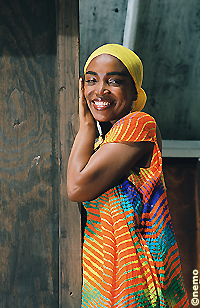
Emeline Michel
A Haitian singer with global commitment
Paris
04/08/2005 -
 |
|
Emeline Michel: I started out as a soloist in a choir, and came 10th in a competition organised by American Airlines in 1987. That gave me the opportunity to record my first song, and to get heard across Haiti. In 1988, I was awarded another prize which allowed me to study at the Detroit Jazz Center. When I returned to Haiti, I composed Flanm, my first hit which launched me internationally. That was around ten years ago and I've continued working ever since. One of the highlights of the past few years were the three months I spent in Jacmel in the south of Haiti, making Cordes et Ame, a very important album in my career, which is now regarded as something of a classic.
Has Rasin Kreyol also been critically acclaimed?
It's an album that mixes rage, nostalgia and hope, reflecting the twists and turns in the recent history of my country, in particular the last couple of years. Musically, I've used traditional Haitian rhythms like 'compas', the most popular dance music in Haiti. It's the music played at big balls, and the style played by Tabou Combo, for instance. Karidad, one of the new songs on my album, takes a nostalgic look back at the big bands of my childhood. The 'rara' is another very popular Haitian rhythm that's traditionally played the night after carnival. Small groups of musicians take to the streets with bamboo flutes, bugles, drums and countless other instruments they've knocked up out of old bits and pieces. They advance in a procession, singing and dancing as they go, drawing a lively, enthusiastic crowd in their wake. People from different social classes and different walks of life come together on this occasion and the fun goes on until dawn. This was my way of saying that we're here, we're still standing and we've still got a whole lot of musical wealth to draw on.
Haitian rhythms aren't the only influence on your work, of course. You've also woven jazz, pop and Brazilian sounds into your musical mix over the year ...
Well, I'm obviously really into Haitian rhythms, but I was also drawn to things I heard on the radio growing up (whether that was Tania Maria, Bob Marley, Nina Simone or Mahalia Jackson). My music draws on all these influences, although I've always strived to make my sound real and authentic.
I'm really grateful for the love and appreciation audiences have shown me back home in Haiti as well as elsewhere in the world – and I'm all the more grateful given the fact that there are very few female artists on the Haitian music scene. That makes me all the more proud!
You eventually decided to set up your own label. Why was that exactly?
I was under contract to Sony-USA and that turned out to be a total waste of time and energy. After having had such a bad experience with them, it seemed absolutely essential to regain some kind of control over my music. And, as the saying goes, if you want a job done well, you'd better do it yourself! At the end of the day, it's important that you're the one signing the cheques and, even more importantly, working out your own career plan. These days, that's exactly what I'm doing and I have to say I'm very happy that's the case!
In the sleevenotes at the end of the album you say that you're "deeply proud" of the fact you were "born in the first black republic." At a time when the debate about slavery is being very much revived, what's your take on the issue?

I'm actually very divided on the issue. I've always seen the recognition of slavery as a very important point to fight for – and I always will. But I'm scared by people who want to stay stuck in the past, who never try to move on and work towards transforming the absurd present we're living in right now. The first three songs on the album are, in part, a reference to that. On the opening track, Bel Kongo, what I'm basically doing is calling for a return to our roots and, at the same time, a rooting out of everything that's stopping us moving on. The song Ban’m La Jwa is in the form of a prayer to the Almighty. In it, I ask Him to spoil us, to keep on giving us all those things money will never be able to buy – strength, joy, patience and serenity. Then there's Beni-yo, a song on which I celebrate the courage of those who are prepared to put their lives in danger as they fight for freedom and change.
There's another song on the album, Lom Kanpe, about the different treatment meted out to Haitian and Cuban refugees arriving in the U.S. When Haitians wash up on the American coast, not far from Miami as things happened in 2003, they're immediately arrested and thrown into jail, whereas Cuban refugees are granted political asylum. But I haven't forgotten the members of the Haitian diaspora, either. Nasyon Solèy is a song addressed directly to them. There are thousands of us across the world and we've been involved in reconstructing other countries while our own is in a state of utter collapse…
Is the situation in your homeland as alarming as that?
It's absolutely desperate! There's been so much violence, so many kidnappings and murders that the French Institute and I decided to cancel the tour of Haiti we were planning between 12th and 24th June to coincide with the 'Fête de la musique.' I was really, really upset about that.
The last song on your new album ends on a more upbeat note, though ..
Mon Rêve (My Dream) is a ballad I do in French, the only one on the album, in fact. It's a song that says it's time for old wounds to heal. It's a dream, a universal dream - a dream of peace!
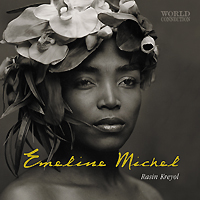
Emeline Michel Rasin Kreyol (World Connection) 2005
Squaaly
Translation : Hugo Wilcken
25/07/2003 -