

 |
A boat ride down the Niger River
by Daniel Brown
Article published on the 2009-03-24 Latest update 2009-03-24 13:39 TU
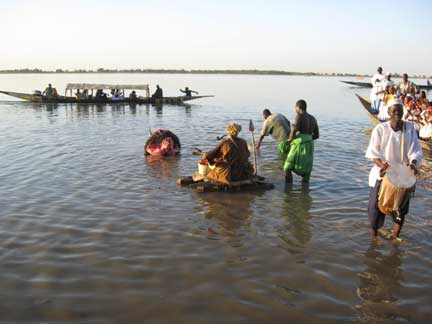
Traditional chief and mermaid in Bozo ceremony
(Photo: Daniel Brown)
One of the main communities in Mali, the Bamanan, believes Man was aquatic in the beginning, and crawled out of a river called the Djoliba, giving birth to the first humans, called the Bozo. Today, the Bozo are a live mainly along the Africa’s third longest river, that westerners called the Niger. This proud community is struggling against desertification and a drop in fish stocks.
Crossroads: On the Niger River with the Bozo
“The Djoliba is the great artery through which blood circulates,” claims Cardigue Laiko Traoré. He is a specialist in Malian traditions as well as being a film actor.
"Djoli means blood, in fact, and the body cannot live without blood. Therefore we believe that this river is the nourishing sap that feeds all people living on its banks, from its source in Guinea to Nigeria, where it discharges into the Gulf. As with all rivers in the world, legends are born here.”
There are around 175,000 Bozo in Mali where they are nicknamed “the masters of the river”. They go back as far as 6,000 years, but they are best known as founders of the cities of Mopti and Djenné around 1,000 years ago.
But this glorious past has given way to a dogged attempt to preserve their nomadic traditions along the banks of the Djoliba river. Like so many ethno-linguistic groups in Mali, they are under threat from environmental disaster combined with the pressures of globalisation.
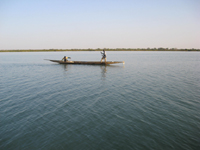
Mamadou Sinayogo on his pirogue
(Photo: Daniel Brown)
For generations now, Mamadou Sinayogo’s family have been making pirogues. They build them in the traditional Bozo way, carving them out of the kaïssedrah tree and using a mix of shea butter and baobab tree powder, to make them water-resistant.
Mamadou is the president of the Fishermen’s Association in Ségou, some three hours drive east of the capital Bamako.
There are some 12,000 pirogues in Ségou, and he has ten which he uses to fish, or to transport either sand or tourists. Mamadou is a proud member of the Bozo community.
He was eager to show the resilience of a people, forced into a semi-sedentary life by King Sheikhou Amadou two centuries ago. We met the bespectacled veteran on the banks of the river in Ségou.
“Yes, there are several kinds of pirogues,” he explained as he worked on his pirogue. “There are the medium-sized pirogues that measure six to eight metres long. It’s used for fishing, using what we call sleeping nets. We also use pirogues that measure between 12 and 15 long. It’s to fish using big nets, we make circles with them, with five people at each end, then they pull it together."
There are other pirogues built to transport sand and gravel, Sinayogo says.
Mamadou Sinayogo knows the 1,700 kilometres of Djoliba river in Mali like the back of his weathered hands. His pirogues have travelled the length and breadth of it for almost 40 years, and he even showed French audiences the art of making these boats a decade ago, when invited to the town of Angoulême.
For the Bozo have turned pirogue-making into a fine art.
“This is my boat," says Sinayogo. "I’ve given it a very personal sign to differentiate it from everyone else.
"I’m going to take you upriver now to a Bozo fishing village. The Bozo are nomads, always on the move. You’ll see how they live day-to-day. It’s a lovely life, a lovely life.”
We navigate the river which is as flat as a pancake. Occasional ripples slap against the pirogue as it crosses fishermen slinging out their fishing nets.
“We’re ten kilometres from Ségou now,” explains Sinayogo. “We call this place Kanzangou. It’s not the scientific name, it’s from our Bozo language. Here, every year, we forbid fishing for four months. It’s to preserve our fish. At the end of the fourth month, we gather all the fishermen and go fishing all together.
"Each fisherman gives a little to our association. Then, we help women to sell their fish on the market, and also give families medication. That’s how we organise ourselves."
Sinayogo boasts that the group receives no government help.
"We are totally self-sufficient. If we don’t do it, no-one will. We were born on the river, we grew up on it – it’s our entire life. That’s why we must protect this river. Our lives depend on it, we must protect it.”
Sinayogo has also set up a pirogue ambulance system, using money from the European Union. However, for the moment even that has dried up, depriving him of a vital mechanism for assisting the Bozo, and especially women about to give birth, with emergency assistance.
“These families are part of the Bozo people, the masters of the river,” he says, pointing to a group of women and children in front of several thatched huts.
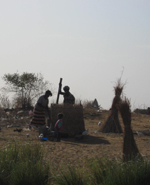
Bozo woman pounding millet
(Photo: Daniel Brown/RFI)
"They arrived recently, and set up here. The women are cooking, the men fishing. They just set the sleeping nets. Here you see fish cages we call nasse. The women guard them. This is where the fish are kept alive, as a reserve. If the fishing has been bad today, they sell this reserve in the Ségou market.
"Just over there, behind this settlement, you see herdsmen with their cattle. They are the Fulani tribes. We live alngside them. We give them room to graze, always. We leave them the place and move on. We never stay in one place for more than two months. Here we see at least 20 families, each one with a thatched hut. And these nomads move between the towns of Mopti in the north, Ségou here and, in the south, Koulikoro”
A woman is sifting through millet and seeds. She is mashing up the millet into a paste.
“We came here a month ago," she says. "This is a good place to stay. The fish wasn’t very good last week, because the Markala Dam that controls the river was low. But the water has risen this week, so it’s been better.
"We’re Bozo, and all we have is this river. We couldn’t live anywhere far from its banks. My husband and I left our hometown two years ago, and we continue to be nomads.
"But things have got much worse in my lifetime. When I was a child all these banks were inundated with fresh water. It’s been years that the water has not been that high. It’s gone down by more than 20 metres!
“I was born on the edge of the river. It used to be so abundant we would trade our fish with the Dogons, for their onions. But now, it’s got dirty, there are plastic bags everywhere. That’s bad. People no longer clean up behind themselves.
"All Bozo must unite to save the environment. We must plant trees, not litter."
Mamadou Sinayogo does not hide his bitterness.
“Our association launched an appeal to all fishermen a month ago. If they see plastic bags in the water they are to pick them up and burn them. Because they are really damaging our river. They cover our algae at the bottom and the fish can’t eat them any more.
"We’ll crack this problem, too. Alone, of course. The government’s never given us a centime, never a centime. I’m saying this loud and clear. If anyone here has been given a centime, let him call me. It’s only us and our friends who’ve done something…that’s all.
"How do I explain? Oof! My dear, we’re nobodies, no one defends us at government level. If I’d been elected to the National Assembly, the realities for us Bozo would be different, that’s for sure.”
The situation remains critical for the Bozo community. Their river level has dropped by around 20 per cent. The Djoliba River loses some 200,000 acres a year to the desert.
Of course, it’s not just the Bozo who depend on the river.
About 110 million people in five countries eke a living from it. This population is set to double by 2025. Promises of international aid, emergency sessions, charters such as the 2008 Declaration of Paris.
All have come and gone, like high and low tides, that are leaving the Bozo and their distant cousins high and dry.
Crossroads

East Africa's first rapid reaction military force
Christopher Thomson reports from a training exercise with the African Union's new regional peacekeeping army in East Africa.
2010-02-16 14:04 TU
Plastic political elite on TV
Kenya's XYZ show uses plastic puppets to poke fun at politicians, encourage democracy and let Kenyans poke fun at themselves.
2010-02-09 13:31 TU
The battle for biodiversity
The United Nations has declared 2010 as International Year of Biodiversity to highlight the devastation of the world’s species.
2010-02-02 09:43 TU
Kenya's biggest microfinanciers
In the second of a two-part report, Aidan O'Donnell visits a micro-finance group in Kenya called Jamii Bora. From small beginnings, it has become the biggest such company in the country.
2010-01-26 12:22 TU
Kenya's biggest microfinanciers
Crossroads visits a micro-finance group in Kenya called Jamii Bora which, from small beginnings, has become the biggest such company in the country.
2010-01-26 12:36 TU
Debate: Killing and rape on all sides in the DRC
Has the Congo-UN offensive gone badly wrong? Brent Gregston discusses the situation with a panel of experts.
2010-01-12 12:07 TU
Has the UN offensive in the DRC gone wrong?
A UN-backed operation in the eastern DRC - Kimia II - has been suspended amid reports of war crimes by the Congolese army. Crossroads asks whether the Congo-UN offensive has gone badly wrong?
2010-01-05 14:19 TU

History, religion and cooking in Cape Town
A walk through Bo-Kaap area of Cape Town, looks at the coming of slaves to the Cape, the emergence of Islam, mouth-watering cuisine and a long-running New Year tradition.
2009-12-29 11:15 TU
Rediscovering the magic of Christmas in Cape Town
Crossroads investigates how children in South Africa are rediscovering the magic of giving Christmas presents thanks to an innovative Non-Governmental Organisation called Kidz to Kidz.
2009-12-22 17:09 TU