

 |
  |

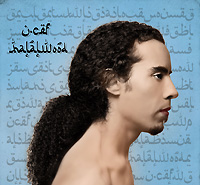
U-Cef's second album
Welcome to "Halalwood"!
Paris
29/10/2008 -
After a brief spell in France, U-cef went to the U.S. where he explored Detroit and New York. "When I headed off to New York," he says, "I still had this idea at the back of my mind that I was going to mix rock and funk with melodies from the Maghreb. The only problem was that there weren't actually a lot of musicians around capable of playing that. I ended up playing a whole lot of different stuff myself - and I played a lot, regularly performing up to five nights a week. New York was a good school in that respect!"
In 1994, U-cef upped sticks and moved to London where he had to rethink his career from scratch. "Once I moved over here," he explains, "I was more or less forced to learn how to work in the studio. There are loads of rehearsal spaces in New York, music's very much out there in the street. But here in London you can't just base your career on playing drums! The city's very isolating for a musician. There are 10,000 recording studios - but they're all in people's bedrooms!"
Armed with a sampler and a rhythm box, U-cef finally got round to recording his debut album, Halalium, in 1999. This consummate mix of the 'halal' sounds he had grown up listening to in Morocco and the trip-hop and drum’n’bass beats he had encountered in the UK brought him instant acclaim. Yet he has only now, after eight years, got round to recording a follow-up. U-cef insists that, despite the eight-year gap between albums, he has been "working like a madman… 'Halalwood' took me five years to complete. Believe me, you can't cobble together an album like this in a few months - not on my budget anyway!"
Hendrix in Morocco

On Boolandrix, U-cef delves into the music annals, reviving a little-known period in rock history. "I wanted to tie this track in with Jimi Hendrix's trip to Morocco in the '70s," he explains, "Hendrix spent time out in Morocco playing with local Gnawa and Berber musicians and this track is my version of something he never actually recorded. 'Boolandrix' is based on the song 'Samaoui', also known as 'Boolandi'."
U-cef is keen to expand on the historical links between Western rock and North Africa. "Plenty of rockers visited the Maghreb," he says, "Led Zeppelin went out there and jammed with Arab and African musicians. And you'll notice that Led Zep compositions are totally different from the work of other rock bands from around the same period. I'm sure that's because they drew on diverse experiences like this." U-Cef has indulged in his own form of musical experimentation and cross-cultural fertilisation, too, writing Stick - a compelling fusion of minimalist pop, dub beats and Arab strings - in collaboration with the British music star Damon Albarn (of Blur and Gorillaz fame).
Pulling out all the stops

Working in collaboration with Rachid Taha, U-cef has also recorded a convincing remix of Ya Rayah, one of the French Algerian singer's biggest chart hits. "(Taha's producer) Steve Hillage is a big mate of mine," says U-cef, "I have a lot of respect for Steve and Rachid. These guys are brilliant at pushing back musical limits. Anyway, one day I got in touch with them and suggested remixing 'Ya Rayah'. Thanks to those two, that song got played everywhere, it's crossed all kinds of borders and geographical frontiers and it's known way beyond the Maghreb now. It just so happens that I've always dreamt of putting my own stamp on 'Ya Rayah,' but Barclay and Universal have always been inflexible over the rights. So when I finally got permission to remix 'Ya Rayah' I understood what a big deal it was! Obviously, we could just have gone ahead and done a straightforward cover of the song, but I wanted to work with Rachid's version. That's the version everyone knows, not the original by Dhamane El Harachi."
U-cef also teamed up with the French Tunisian singer Amina Annabi to record a cover of Inta oumri (a classic immortalised by the legendary Egyptian diva Oum Kalthoum). "Amina and I had been wanting to work together for a long time," says U-Cef, "What happened was Amina came over to London for a couple of days, but didn't actually have much spare time. We started out trying to do our own song, I already had the beats and the melodies ready, but when Amina started to do the vocals I realised it was going to require a lot more work. So I suggested doing a cover (of 'Inta oumri') instead. Amina knew the original so all I had to do was bring in two musicians - a keyboard-player and a violinist - and I finished off the track later with a couple of DJs." The result is a scintillating and highly respectful Kalzoom which, like the rest of Halalwood, should satisfy older music fans and keep younger clubbers happy at the same time!

U-Cef Halalwood (Crammed Disc) 2008
Ludovic Basque
Translation : Julie Street
05/04/2006 -
27/05/2005 -
04/06/2002 -