
 |
  |

Rokia Traore: From new discovery to star
An Album Of Sweetness and Groove
Paris
12/04/2000 -
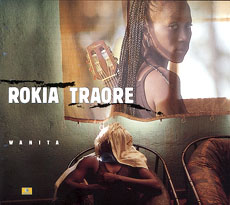 Rokia Traoré is well on the way to proving the old proverb "Great oaks from little acorns grow". Building up her reputation without the aid of full-blown publicity or massive media hype, Rokia has worked away, playing concert after concert, and her fame has spread slowly but surely rather than blossoming overnight. An increasing number of fans have been turning out to Rokia's concerts and the Malian diva recently brought the house down when she performed at the Café de la Danse in Paris. Meanwhile, sales of the singer's first album (released in 1998) have continued to climb, topping the 20,000 mark in France.
It's hard to believe that when Rokia made her debut at the 1997 edition of the "Musiques Métisses" festival in Angoulême, she had only just turned 23. But while the young singer was a complete unknown to French audiences she had already built up a strong following of fans back home in Mali. Indeed, several leading stars on Mali's music scene had acted as Rokia's "big brothers", Ali Farka Touré being just one of the stars who sang the young newcomer's praises. Rokia stayed on in France after "Musiques Métisses" to record her debut album Mouneïssa and, later that year, went on to scoop RFI's "Découvertes Afrique" award. As a result of this award, the young diva was invited on to the special Malian edition of Bouillon de Culture (Bernard Pivot's cultural TV show, recorded live in Bamako on this occasion).
Rokia was actually born in Bamako where she spent much of her childhood. But the young girl also got the chance to travel the world with her diplomat father (now retired) who introduced her to different cultures and customs. Rokia has fond memories of her early years, recalling the wild daisies which used to grow everywhere in Algeria and the picturesque neighbourhoods of Brussels which, she says, still seem strangely familiar to her today. Rokia has equally fond memories of her school in Bamako where she experimented with rap for the first time. "I remember I was really keen on using traditional instruments," the singer says, "But back then everyone thought that was a very unhip idea.". (These days Rokia is glad to see that several rap groups have actually adopted her ideas!)
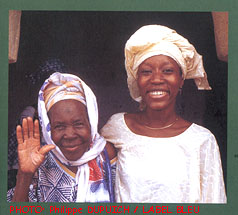 After school Rokia went on to university to study social science but eventually dropped her studies to launch herself as a professional singer. "My career choice came as a bit of a shock for my parents," the singer recalls, "They really weren't expecting it at all!". And yet Rokia's father had already dabbled in the music world himself in the past, writing songs and playing sax, but fathers in Mali (like most other places for that matter) often have other plans for their daughters. Rokia insisted on following her vocation and, after a month's training with Koteba in Abidjan, the headstrong young singer set about recruiting a group of musicians to play traditional instruments (balaba, ngoni, gaïta, karignan, djembé etc.) .
Rokia then got down to work on her songs, setting the lyrics she'd penned in Bamanan to a fusion of modern sounds and traditional rhythms. Following the success of her first album, Mouneïssa, Rokia is now back in the music news with Wanita, an album which takes her original style one step further. Breaking away from the flamboyantly lyrical style of her Malian sisters, Rokia created a more reserved style on Mouneïssa, enchanting audiences with delicate vocals and soft, slow ballads. On her second album Wanita Rokia has chosen to branch out in a new direction, however, deliberately fusing sassy upbeat dance numbers with more reflective dreamy ballads.
The singer explains that this new-found dynamism was inspired by listening to a wide variety of music after she finished recording her first album. One of Rokia's most exciting new discoveries was Indian ragas: "I came to realise that certain aspects of traditional music from India and the south of Mali were very similar," says Rokia, "There's a great deal of similarity in certain tonalities for example. That's why on the song "Souba" I've tried to create a bit of an Indian 'ambience'." Rokia has also been influenced by more frenetic sounds such as the uptempo jazz-rock of Joe Zawinul. "I realised that I've come to enjoy listening to more energetic music too," she says, "And naturally that's how I moved on to creating more dynamic songs myself."
The swirling musical rhythms of Wanita are certainly proof of Rokia's new-found energy. What's more, Rokia's high-voltage energy has also worked its way into her live appearances and fans will now find the singer throwing herself around stage with gay abandon, performing exuberant dance routines. In other words, Rokia Traoré has come a long way from her debut as a timid newcomer at Angoulême just three years ago!
Patrick Labesse.
ALBUM : Wanita (Indigo)



19/05/2008 -
03/04/2007 -
29/09/2003 -